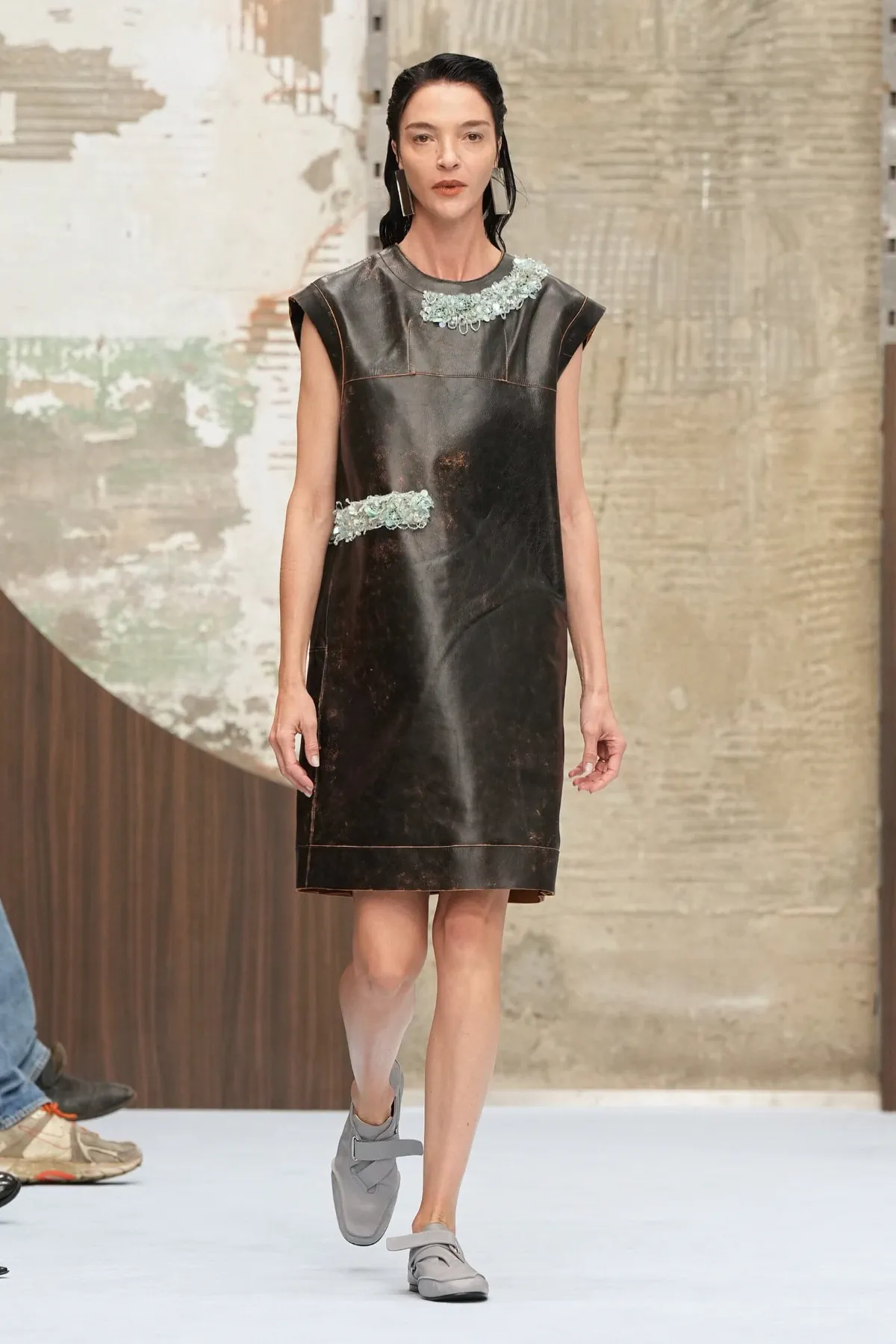

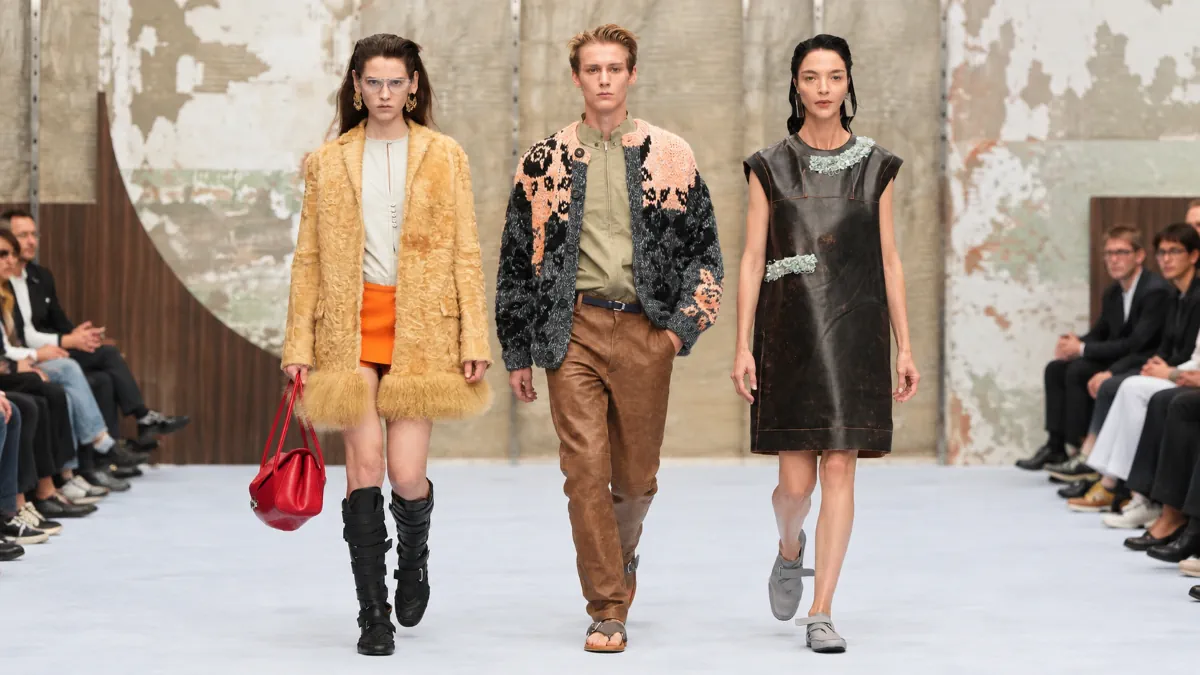
| On September 24th, 2026, Meryll Rogge presented Marni Spring 2027 in Milan, marking her second collection for the house. The collection featured dresses made of raw calfskin with exposed seams, visible linings, and exaggerated hardware. Mariacarla Boscono closed the show in a black leather dress adorned with aquamarine beading. The collection continues Rogge’s efforts to refine, rather than replace, Marni’s established codes. |
Marni has never wanted to be liked in an ordinary way. For Spring 2027, Meryl Rogge proved that the house’s oddness can survive a change of hands and be sharpened under new ownership. Shown in Milan this week, her second collection for the brand answered a question that had lingered since her appointment last year: Would she make Marni more mainstream, or would she maintain its eccentricity? She kept it crooked, and the result was more confident than her debut.
Rogge is not interested in reinventing Marni from scratch. Backstage, she said as much, describing her job as figuring out what to keep rather than what to discard. That distinction matters. When a designer inherits a codified house, there are two paths: erase the past or negotiate with it. Rogge chose negotiation, pulling familiar Marni elements forward and giving them a firmer, more industrial edge. The timing alone raised the stakes: Her Thursday show was scheduled during the same busy period in Milan’s fashion calendar as Maria Grazia Chiuri’s second collection for Fendi and Demna’s second for Gucci. This week, the industry was watching to see which sophomore statements would solidify as house codes and which would fade away.
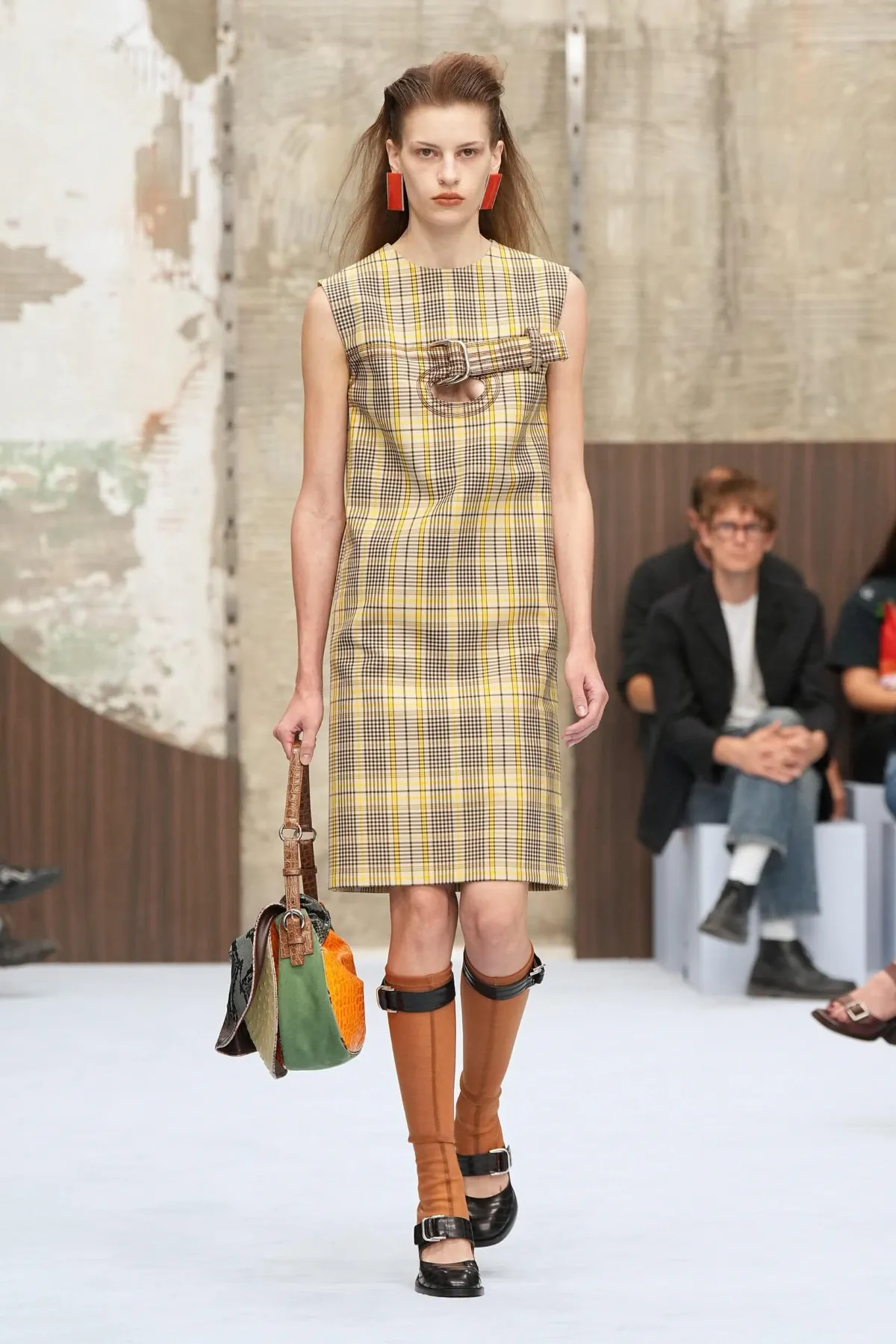
The clothes made her thought process visible. Sack dresses appeared in raw calfskin, their softness roughened into something closer to brutalist than sweet. A beaded appliqué, clearly lifted from one silhouette, resurfaced on another, functioning less like decoration and more like a found object that someone forgot to put back. Rogge called this layering “a decoration on the decoration,” a phrase that better captures her method than any show note could.
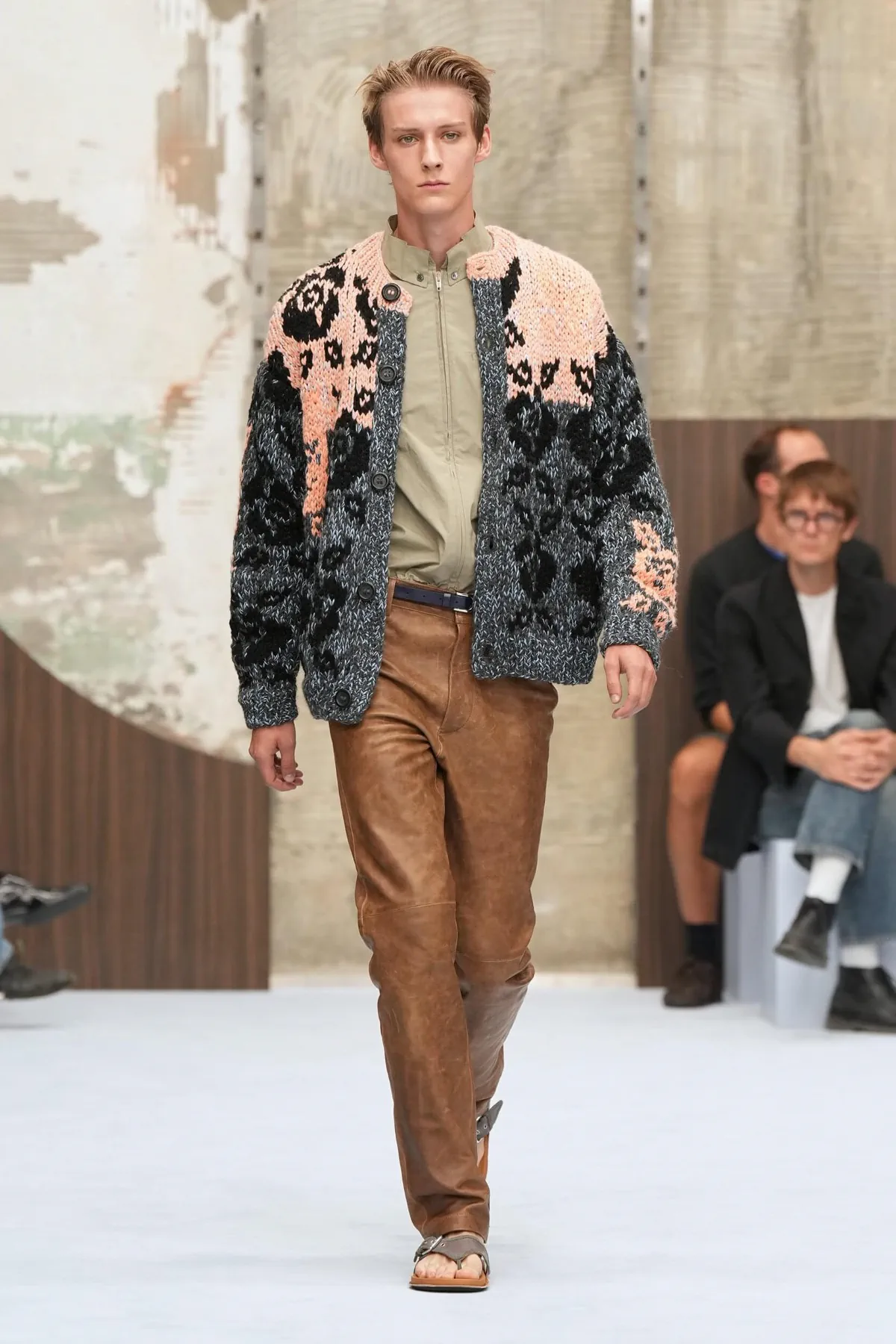
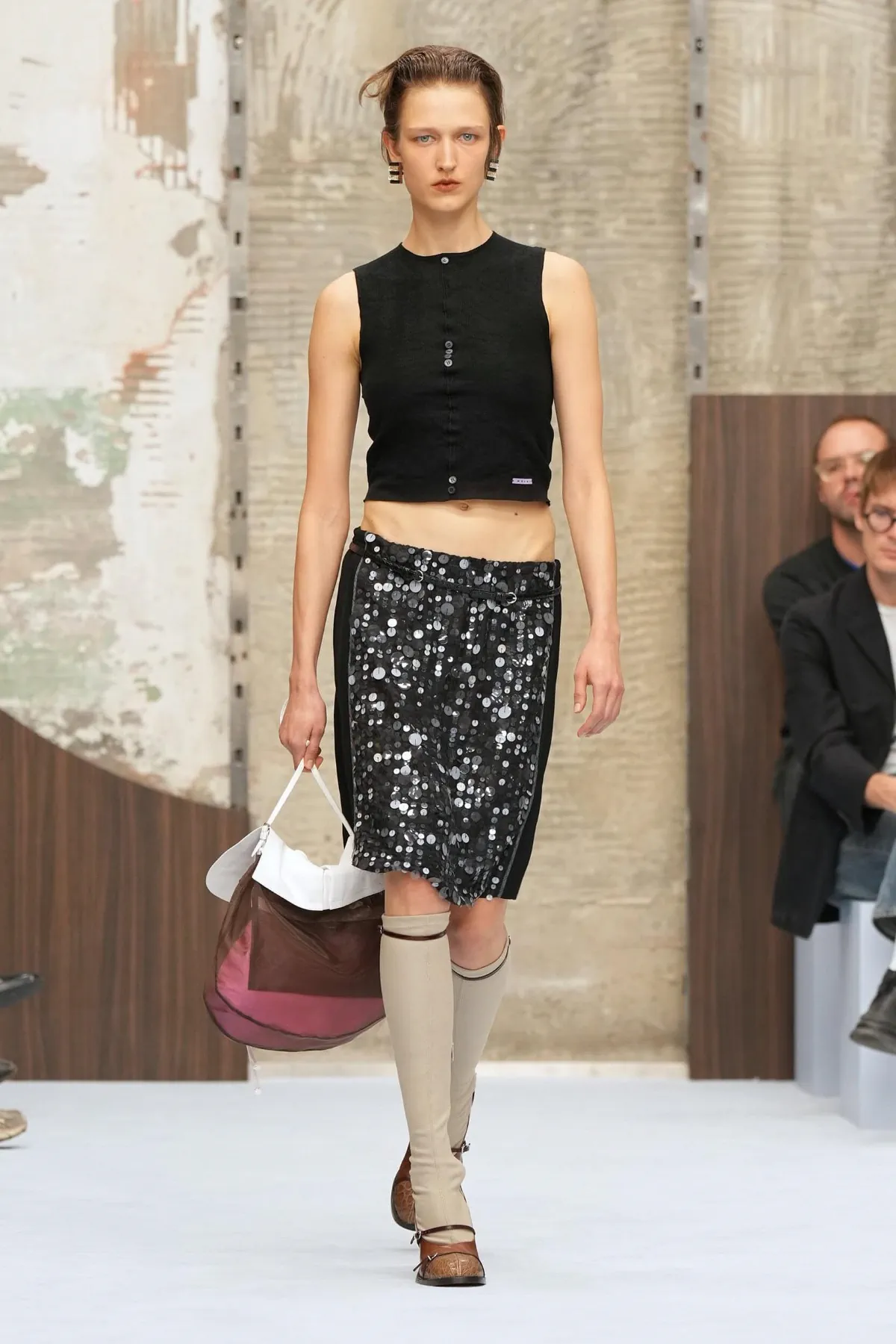
Scale did a lot of the talking, too. Buckles swelled to cartoonish size in one moment and shrank to almost nothing in the next. Marni’s signature elastic was enlarged, and tiny buttons, usually an afterthought, were placed on leather and heavy wool, suddenly becoming important. An abstract print took a recognizable ’60s silhouette and flattened it into something you had to squint to identify. None of this felt arbitrary. It felt like someone was testing how far a code could stretch before it snapped.
Where Rogge pushed hardest was in the construction itself. Linings turned outward. Seams were left exposed rather than hidden, as if the garments had nothing to hide. One dress had a bra outline sewn directly onto its surface, making the underlayer the main event. The industrial triple stitch, usually invisible, became a visible signature running across several looks. Hardware bounced between clothing and accessories, with no clear hierarchy between the two.
The womenswear shapes remained slender and tubular, with shift dresses made of leather or duchesse satin providing much of the structure. Mariacarla Boscono closed the show in black leather adorned with aquamarine beading in an arced pattern, a nod to Marni’s history delivered by a model who has embodied that history herself. Her appearance held special significance this season, coming just two days after she opened Vogue World in the same city. This meant that Marni’s closing look marked the second time in one week that Boscono had brought the brand into a conversation happening well outside the usual fashion crowd. Some dresses had a porthole cutout anchored by a heavy belt, while others had plastic discs that read as pure Marni shorthand. These discs would later be scattered as small sequins across the footwear.
Color leaned on a human reference rather than a seasonal mood board. Rogge used grays, browns, blacks, and blondes borrowed from hair shades, suggesting different ages and stages of life without reducing them to a demographic chart. This approach gave the palette a strange warmth despite its restraint.
Follow all the latest news from Fashionotography on Flipboard, or receive it directly in your inbox with Feeder.
You may also read

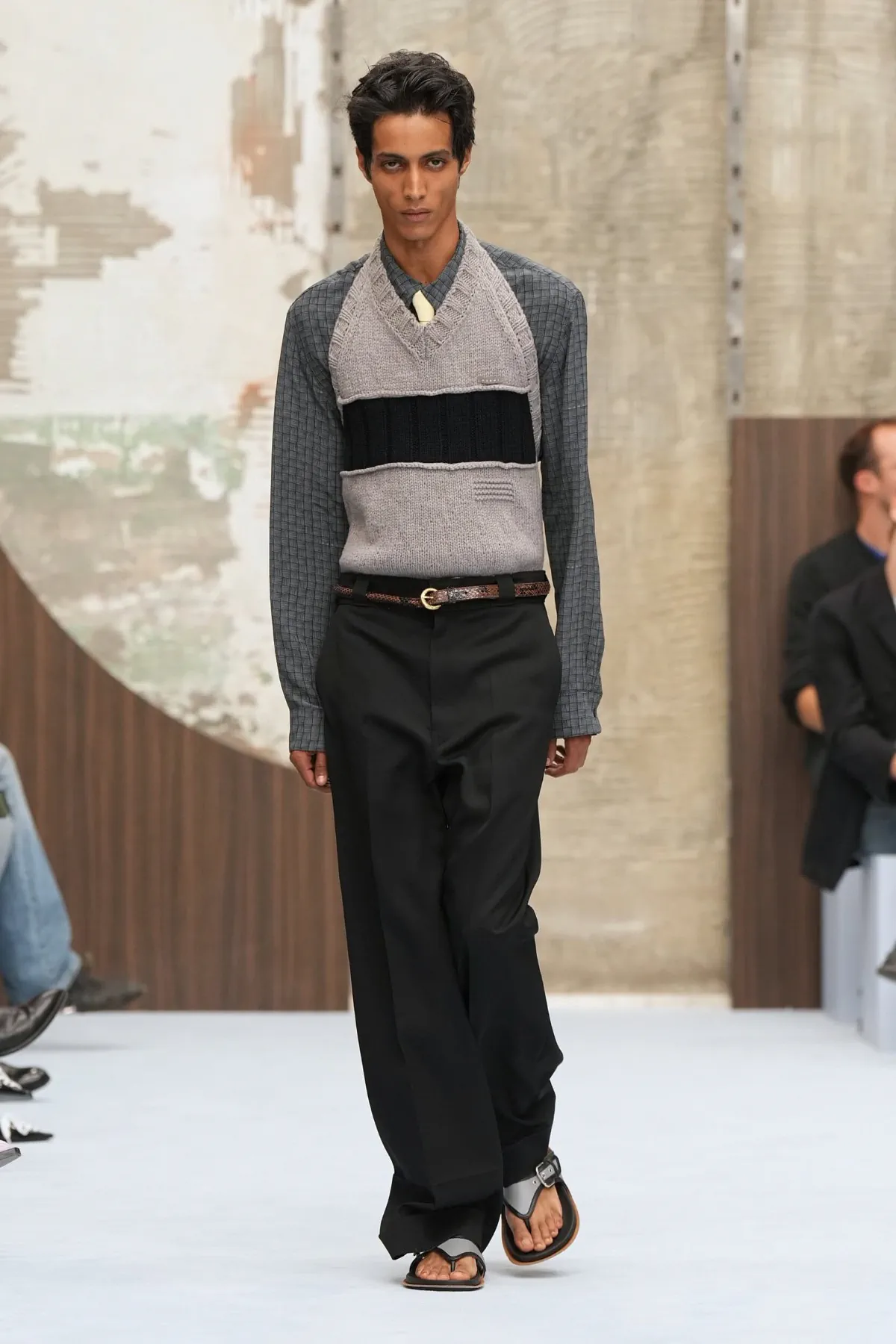
The menswear collection felt looser and, frankly, funnier. Workwear details crept into tailored trousers. Color-blocked knits had faint sequin stripes. Halter necks disrupted the traditional male silhouette in a playful, not provocative, way. Rogge described the intent plainly: not flamboyant, just discreet but present. This idea applies to the entire collection.

Even the set followed her logic of addition and subtraction. Working again with Formafantasma, she kept last season’s layout intact and stripped away everything underneath it. Materials from the previous set were pulped into paper and folded into airplanes for the invitations – a small, literal nod to moving forward without destroying everything first.
None of this will reach stores immediately. Spring collections typically start landing in boutiques and on Marni’s website several months before the turn of the year. However, the construction ideas travel faster than the clothes themselves. Exposed seams, visible triple-stitching, and linings worn as the outer layer are spreading well beyond Marni. They’re showing up at accessible price points, from fast-fashion imitators to workwear-adjacent labels. This means the look is one readers can start testing before a single piece from this collection ships.

Marni’s appeal has always rested on a certain resistance to prettiness, an intellectual restlessness that refuses easy seduction. Rogge understands this instinct and has given it sharper tools rather than a new personality. Two seasons in, her Marni still looks slightly wrong in the most deliberate way – and that wrongness is starting to look less like a debut designer finding her footing and more like a house code she’s decided to own.