


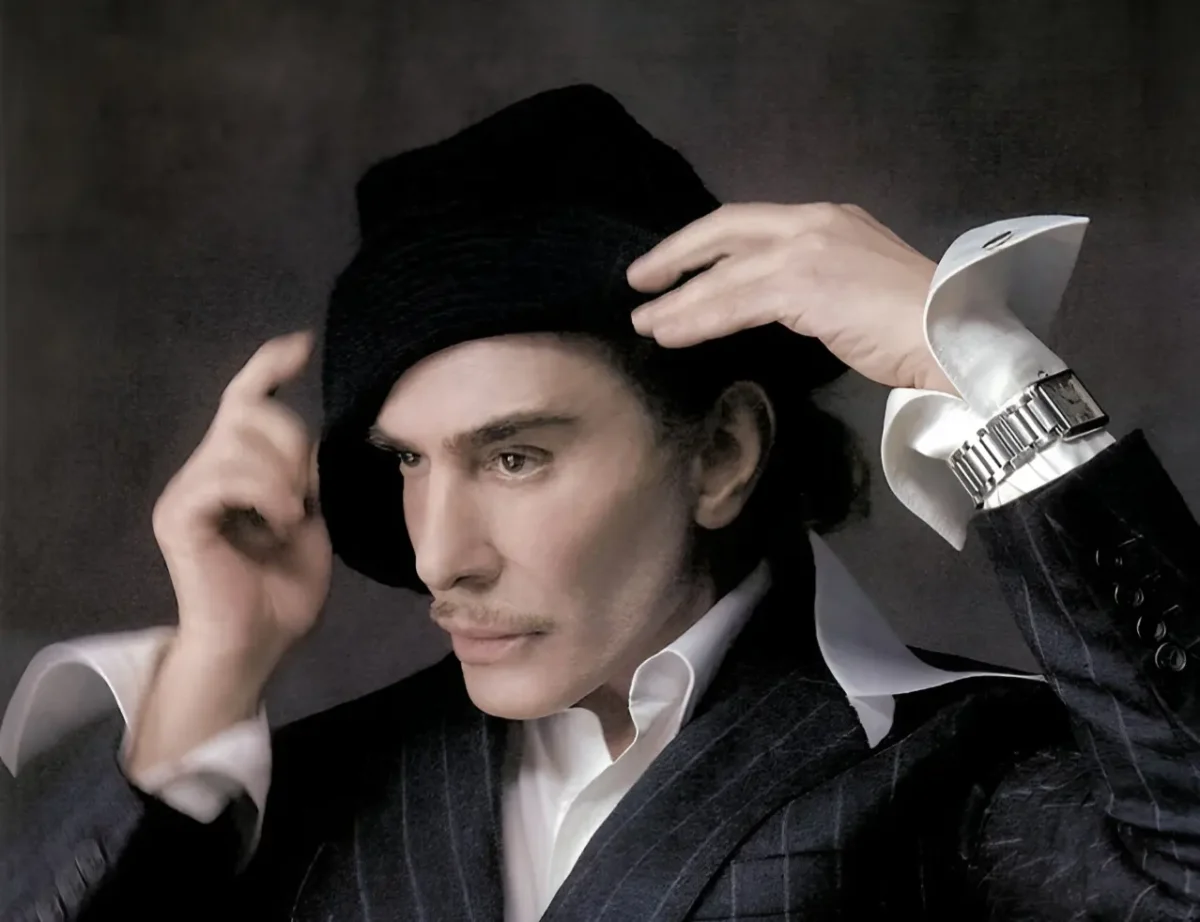
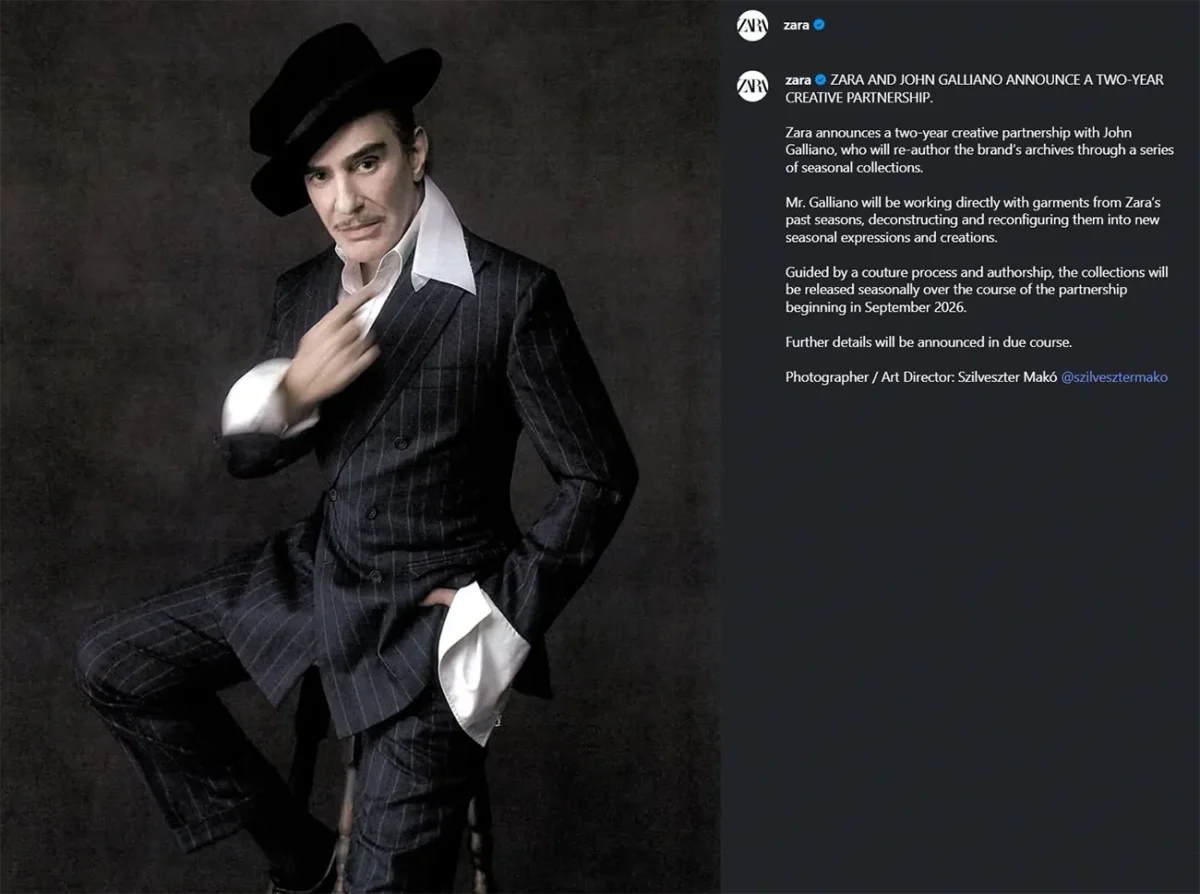
John Galliano and Zara are not two names that typically appear in the same sentence. One evokes bias-cut gowns, epic runway theater, and a reputation for fashion as spectacle. The other evokes efficient supply chains, quick production times, and affordable prices. Yet here they are, formally linked in a two-year creative partnership that will see Galliano working directly with the Spanish retailer’s archives to reshape its past into something new.
Galliano quietly confirmed the rumors circulating in the industry for weeks during Paris Fashion Week. He is not designing a capsule collection. He is not lending his name to a limited run of handbags. In his own words, he is “re-authoring” the Zara archives by taking existing pieces from past seasons and reconfiguring them through a couture lens with new shapes, fabrics, and his “distinctive signature,” according to his team.
An unexpected alliance reshaping fashion dynamics
The project did not come together through an agent or a press release. It began, as many things in fashion do, through a personal relationship. Galliano met Marta Ortega Pérez, the chair of Inditex (Zara’s parent company) and the daughter of its founder, Amancio Ortega, through her MOP Foundation. The foundation presents photography and fashion exhibitions in La Coruña, Spain. Since its establishment in 2022, the foundation has hosted shows dedicated to Steven Meisel and Irving Penn, among others.
“I met Marta through MOP and the wonderful exhibitions that she curates,” Galliano told Vogue. “Through those exhibitions, we started to strike up a friendship. I just like how open she is.“
Ortega Perez has been quietly repositioning Zara since becoming chair. The brand has collaborated with Narciso Rodriguez and Stefano Pilati. It released capsule collections with Kate Moss and Steven Meisel. But those were brief, promotional, and finite moments. The collaboration with Galliano is more sustained and ambitious.
How Galliano plans to reinvent Zara’s archives
Galliano keeps using the word “re-authoring.” Not redesigning, referencing, or remixing. Re-authoring. The distinction matters to him. He and his team have spent months in an atelier outside of Paris – the location is undisclosed – launching toiles, studying proportion, and pushing the limits of what he can do within Zara’s existing archive.
“I’m super excited because it’s not something I’ve done before. The newness, the excitement, the actual process – that kind of tickles me,” he said. “Even with my team, I have to remind them daily: No, it’s not this, and it’s not that. We are reauthoring. It’s been quite fun, and I just think it’s a very positive thing to be doing right now. It’s also really sustainable from a creative point of view, which I find super interesting.”
Sustainability, in the broadest sense, seems to be a governing idea here. Working from an existing archive means working with what already exists – a creative constraint that Galliano finds liberating rather than limiting. He says the work so far is “informed by form and proportion” and resists easy categorization. “One could safely say,” he noted, “it’s beyond gender and beyond seasons.”
The first collection will reach stores in September 2026. Further details are expected as the project develops.
| 📌 Key Facts |
|---|
| 🎯 John Galliano has entered a two-year creative partnership with Zara 🧵 The project focuses on reworking the brand’s existing archives rather than creating from scratch 📅 The first collection is scheduled to launch in September 2026 🌱 The approach emphasizes sustainability through transformation, not production 🏛️ The collaboration began through Marta Ortega and the MOP Foundation 📈 Zara continues to strengthen its cultural positioning through high-profile collaborations 🔥 Galliano returns after a two-year break following his departure from Maison Margiela |
A creative method built on sustainability and constraints
Galliano has been away from the fashion industry since his final show for Maison Margiela: the Spring/Summer 2024 Artisanal collection. This tour de force featured encrusted lace, new techniques, and fabric turned into sequins. His team called it “emotional cutting.” It was one of the most talked-about shows of that year. Shortly after, he stepped away.
His decade at Margiela, under owner Renzo Rosso, had been a genuine second act. When he arrived, the house was artistically revered but commercially modest. By the time he left, sales had grown to around $500 million, roughly five times what they had been. The designer and proprietor had built something together that felt inexhaustible for a long time.
Before Margiela, there was Christian Dior. Galliano served as creative director from 1997 to 2011 – a tenure longer than that of the house’s founder – before a very public unraveling cost him everything. His return came in stages: a brief residency at Oscar de la Renta in 2013, followed by Margiela. Rosso offered him the kind of clean slate rarely given to fallen figures.
The two years since Margiela have been spent differently. Galliano describes walking through forests without his phone, visiting museums, and reconnecting with what he calls instinct. “It’s been precious time to really think about what I want to do next,” he said. “You think, ‘Oh, that’s what you have to do,’ and ‘Oh, you’re going to be this for the rest of your life,’ or ‘You’re going to be that.’ But at some point, it’s good to just step off and think.“
Follow all the latest news from Fashionotography on Flipboard, or receive it directly in your inbox with Feeder.
You may also read

Galliano’s career reset and strategic comeback
Whatever doubts anyone might have had about Galliano’s continued cultural significance were quietly answered earlier this year. He sat front row at Jonathan Anderson’s haute couture debut for Dior. Anderson, who has spoken openly about Galliano as a formative influence, designed a collection that paid direct homage to his predecessor. He incorporated cyclamen, the flower Galliano had presented to Anderson at their first meeting, across multiple pieces.
“When I was in school, even before, John was a hero of mine,” Anderson said at the time. “To me, he is Dior in the modern world.“
Meanwhile, his work continues to find buyers at auction. Bonhams New York is currently selling a series of Y2K-era, bias-cut slip dresses from Galliano’s time at Dior as part of an online sale running through March 20. Marissa Speer, Bonhams’ head of handbag and fashion sales in the U.S., noted that Galliano “created some of the most recognizable and sought-after designs of the late 1990s and early 2000s.” She said his bias-cut gowns were inspired by Madeleine Vionnet’s pioneering techniques and remain highly prized by collectors.
Joan Burstein, the 100-year-old retail mogul who famously purchased Galliano’s graduate collection in 1984 and sold it at her family’s boutique, Browns, on London’s South Molton Street, summed it up simply. Times and tastes may have changed, she told WWD, but Galliano “still has it.”
Why Zara is accelerating its cultural repositioning
Galliano’s appointment fits into a broader pattern. Under Ortega Perez, Zara has been systematically acquiring the kind of cultural credibility that money can suggest but not directly purchase. The MOP Foundation’s photography exhibitions featuring Peter Lindbergh, Helmut Newton, Irving Penn, and Annie Leibovitz signal a seriousness of intent that the brand’s merchandise had not always conveyed.
Galliano is aware of the scale he is working with and finds it exciting rather than troubling. “Delivering fashion through that enormous platform is thrilling. And to be able to work with the kind of resources they have, that’s equally thrilling,” he said.
The high street has been attracting talent from the upper echelons of the industry for a while now. Clare Waight Keller, formerly of Givenchy, now leads Uniqlo. Zac Posen moved to Gap. Jonathan Saunders joined & Other Stories. The stigma, such as it ever was, has largely dissolved. As Mary Gallagher of Find Executive Consulting said last year, “There is no longer a stigma or snobbery about going downmarket when the project is exciting to a creative director who wants to build something.“
Galliano, now 65, does not view this moment as a compromise, but rather as the most considered choice he has made. “They say act three of your life is the most important,” he said, “and can be the most fun.”
What act three will look like will become clear in September. Until then, somewhere outside Paris, the toiles are piling up.