


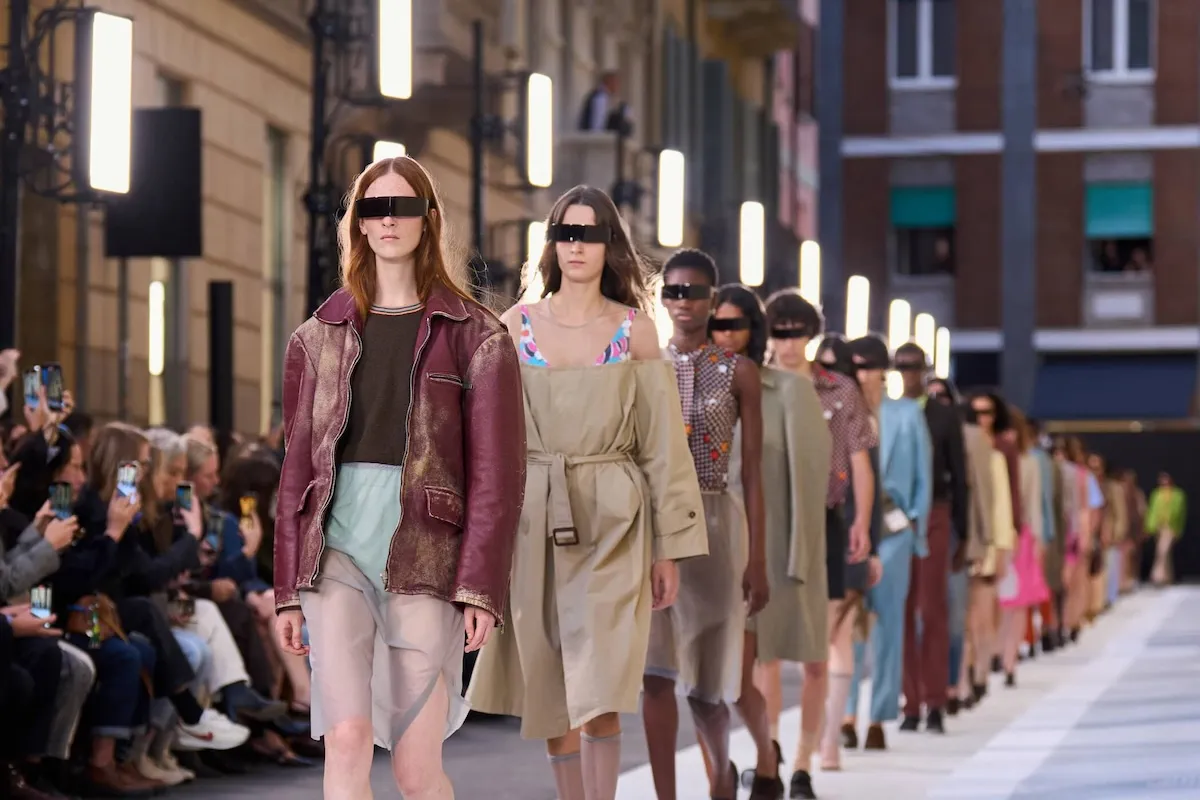
Maison Margiela is orchestrating a significant cultural pivot in Shanghai by scheduling its Fall 2026 runway show on April Fools’ Day to coincide with the launch of its educational campaign. The date feels fitting for a brand built on subversion, yet the ambition behind this “brand moment” is serious. Under the banner “Maison Margiela/Folders,” the brand is executing a multi-city rollout across China to strengthen its relationship with a market it entered in 2019.
| 📌 Key Facts |
|---|
| 🎭 Brand: Maison Margiela 🗓 Event: Fall 2026 runway show 📍 Main Location: Shanghai 🌏 Additional Cities: Beijing, Chengdu, Shenzhen 🎨 Creative Director: Glenn Martens 🧠 Concept: Education, transparency, brand archives 💾 Digital Strategy: Public sharing of internal project files 💰 Estimated Revenue: ~€600 million 🎯 Target in China: Young, female, RTW & footwear consumers |
“April 1st fits very well with our personality,” Sciuto told WWD from his bright, white office in Paris. “We definitely need to grow our community and talk about our DNA, our values, and our codes.” Sciuto, who joined from Giorgio Armani in 2023, acknowledges that while the brand has legendary status in fashion, a broader Chinese consumer base requires context. “If you think about the history of Margiela, every time there’s a Margiela show, there’s something to talk about,” he noted. “Whether or not you’re in favor, you have an opinion. We spark conversations.”
The scale of this project is unprecedented for the brand. Instead of a single runway event, Sciuto has planned a series of activations designed to deconstruct the house’s ethos. Shanghai will host an exhibition dedicated to artisanal couture from 1989 to 2025. Beijing will explore the theme of anonymity, which was central to founder Martin Margiela’s philosophy. Chengdu will showcase the iconic split-toe Tabi shoe through the collections of local enthusiasts. In Shenzhen, participants will coat garments in white paint at an interactive workshop, mimicking the house’s furniture design techniques.
The digital component is perhaps the most radical departure from industry standard. Maison Margiela intends to share the folders containing the logistical blueprints of these events via Dropbox. This transparent data dump includes call sheets, shipping manifests, and creative documentation. “Honestly, I don’t think any brand has ever done that: opened their archives and files to show how the project came about,” Sciuto explained. “I would say this is definitely the biggest global brand moment we’ve ever had.“
This openness contrasts sharply with the guarded mystery that traditionally shrouded the brand. Martin Margiela, the reclusive Belgian designer who founded the house in 1988, famously avoided photographs and interviews. He built a legacy on deconstructed clothes and face-obscuring masks. Today, the business aims to translate that avant-garde heritage into commercial growth without diluting its edge.
Follow all the latest news from Fashionotography on Flipboard, or receive it directly in your inbox with Feeder.
You may also read
Creative director Glenn Martens is central to this strategy. Since taking the helm, Martens has revisited the archives, reintroducing styles like the heel-less shoe and expanding the accessory line with the new Box bag. The Fall 2026 collection will emphasize these linchpin items alongside conceptual ready-to-wear pieces. “Glenn is taking Margiela back to its DNA,” Sciuto observed. “John did an amazing job for ten years and took the brand to a new level of luxury. I think now we need to build on what John accomplished and leverage Glenn’s incredible talent for conceptual design and his understanding of younger generations.“
Financially, the house is on an upward trajectory. Sources estimate revenues at around 600 million euros, thanks to strong performance in Japan and an expansion planned for the United States in 2027. Sciuto describes the current growth as organic, driven by product desirability rather than an aggressive spree of store openings. The target demographic in China is notably young and female and is drawn to ready-to-wear items and footwear.
The challenge for any luxury brand expanding in China is to maintain an aura of exclusivity while courting the mass market. Sciuto is acutely aware of this tension. He uses a specific analogy to describe his growth targets. He prefers not to saturate the market, but rather to maintain a level of scarcity that keeps the brand desirable. “If I go to a party in Paris with 100 people, I might see one person wearing Tabi shoes or a jacket with the lining hanging out or a sweater with a hole. You recognize it’s Margiela, right?” Sciuto said. “So I want five people, not two. I don’t want 50; I want five because that’s how I can grow while staying true to the brand.“
This calculated approach suggests that Maison Margiela seeks to be omnipresent yet exclusive. By opening its archives to the public in Shanghai, the fashion house invites the world to understand its language. The hope is that a deeper understanding of the brand’s codes will foster a more dedicated community. In a luxury landscape often dominated by logos and loudness, Margiela is banking on the idea that intellectual rigor and artistic transparency will resonate with the next generation of consumers.