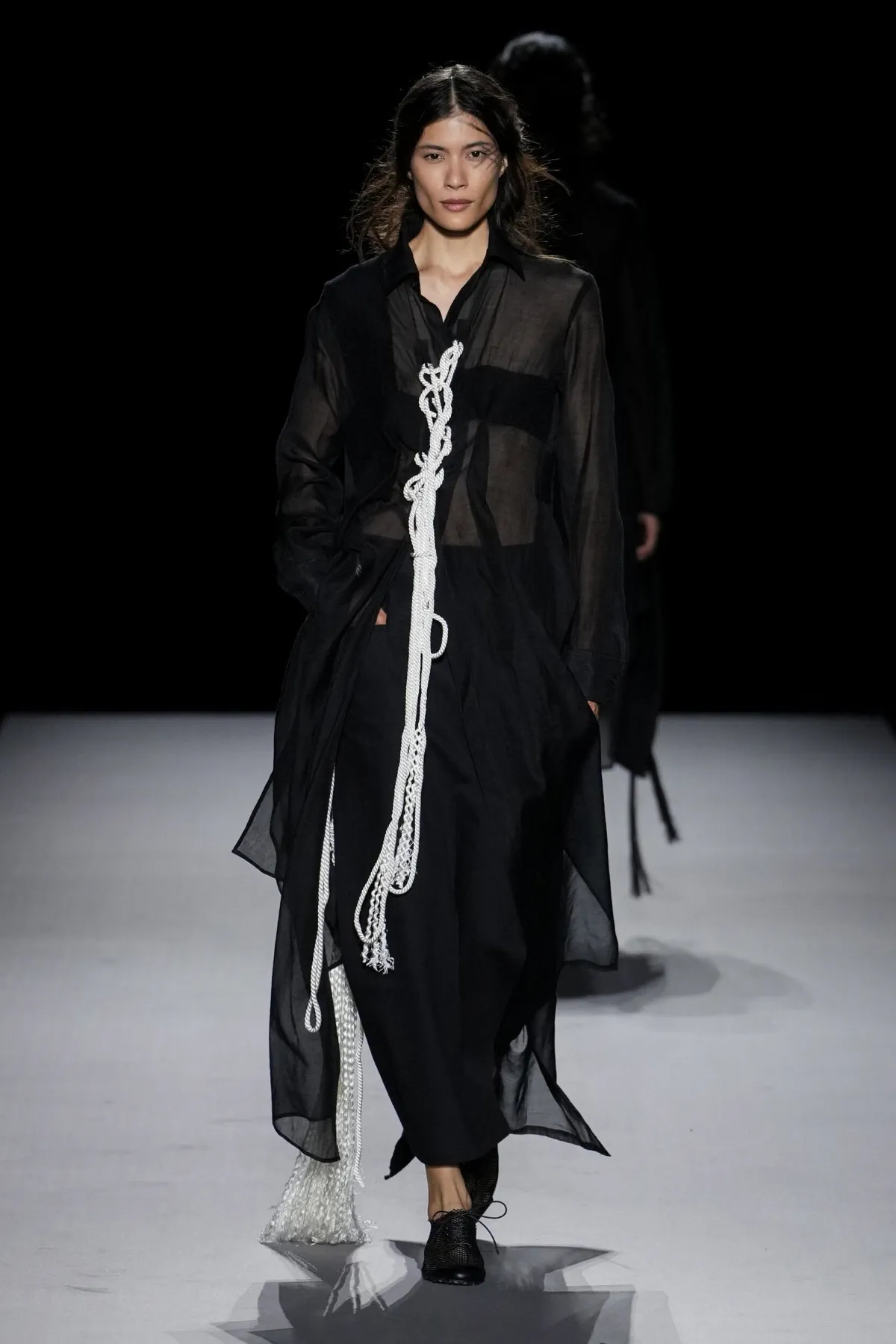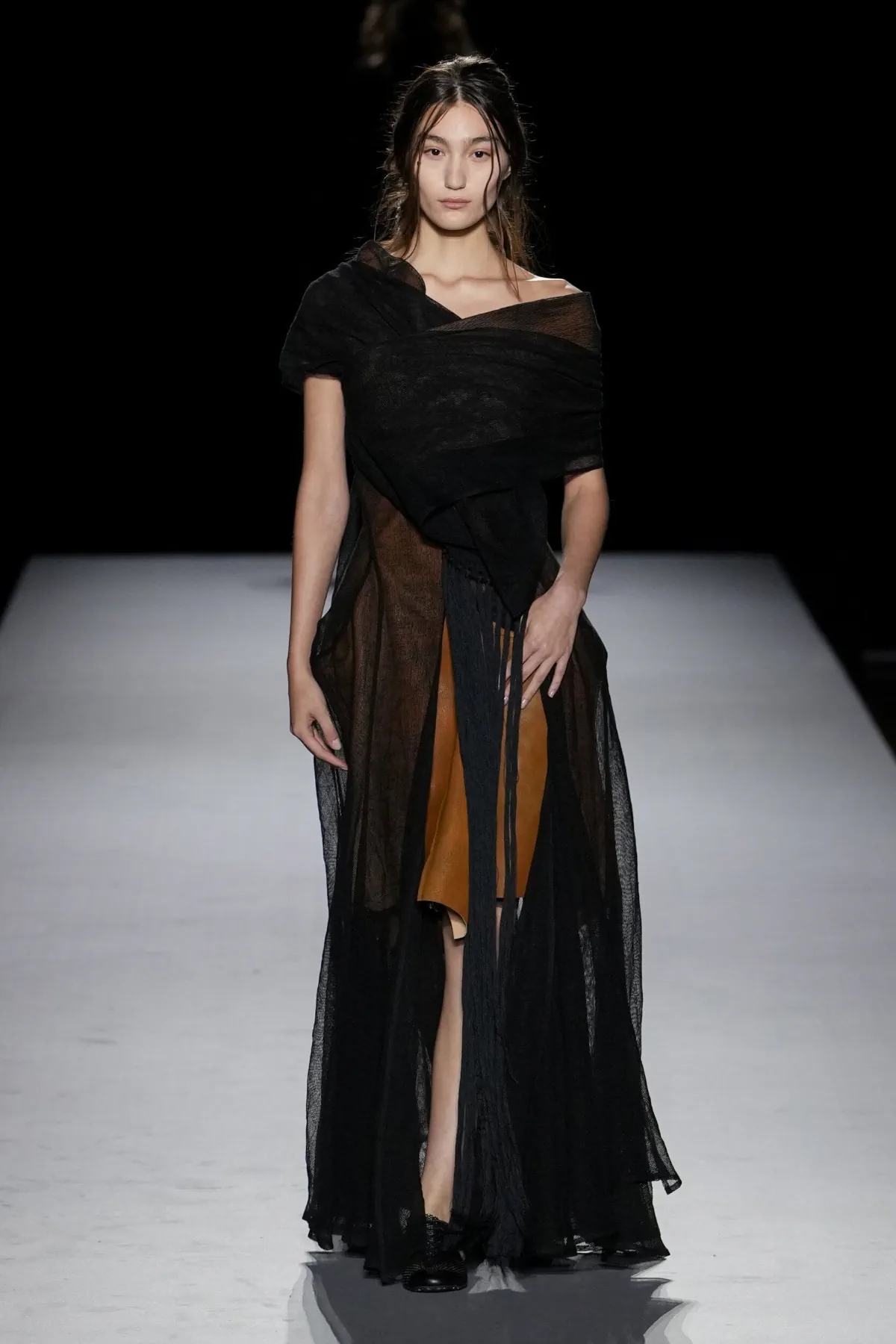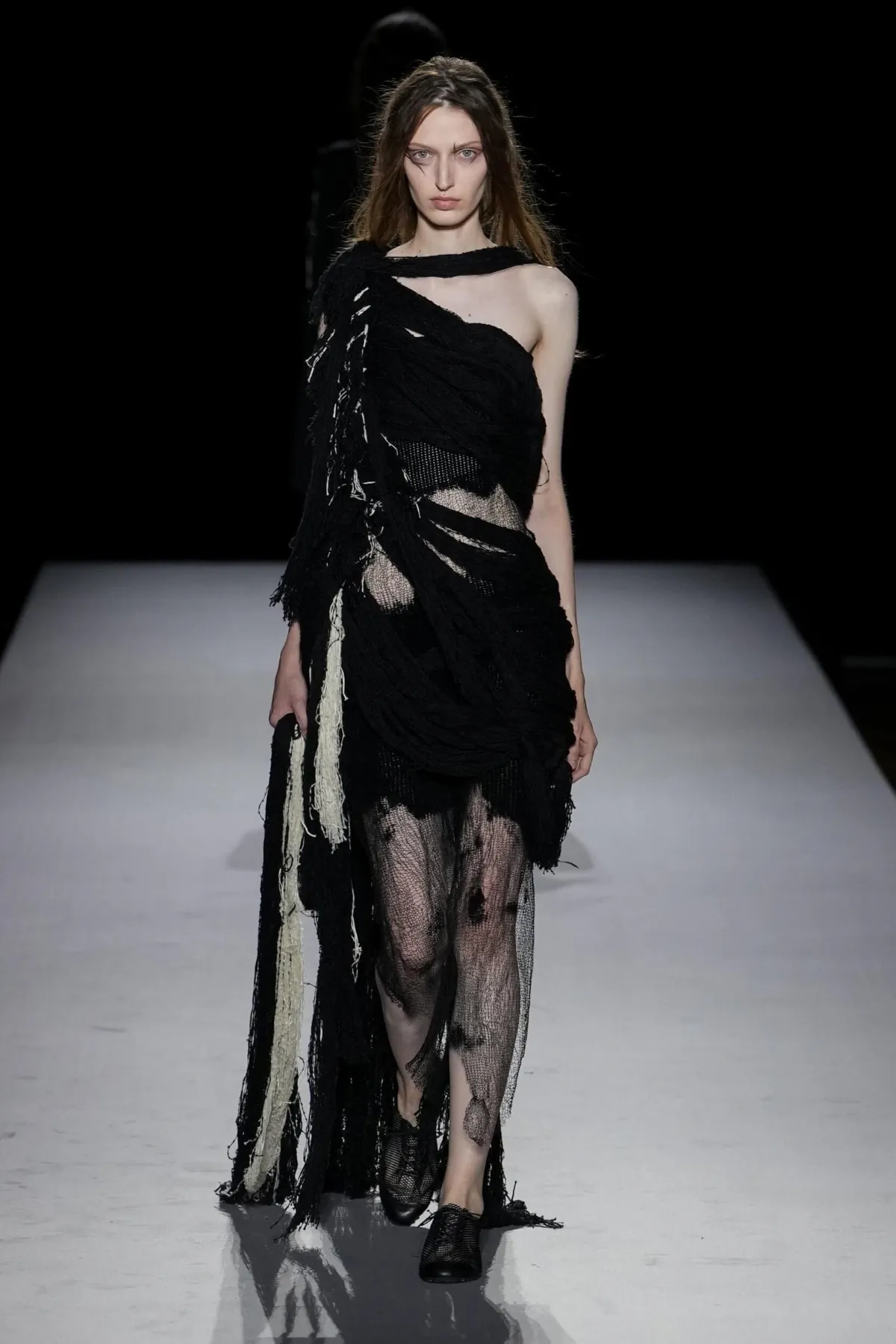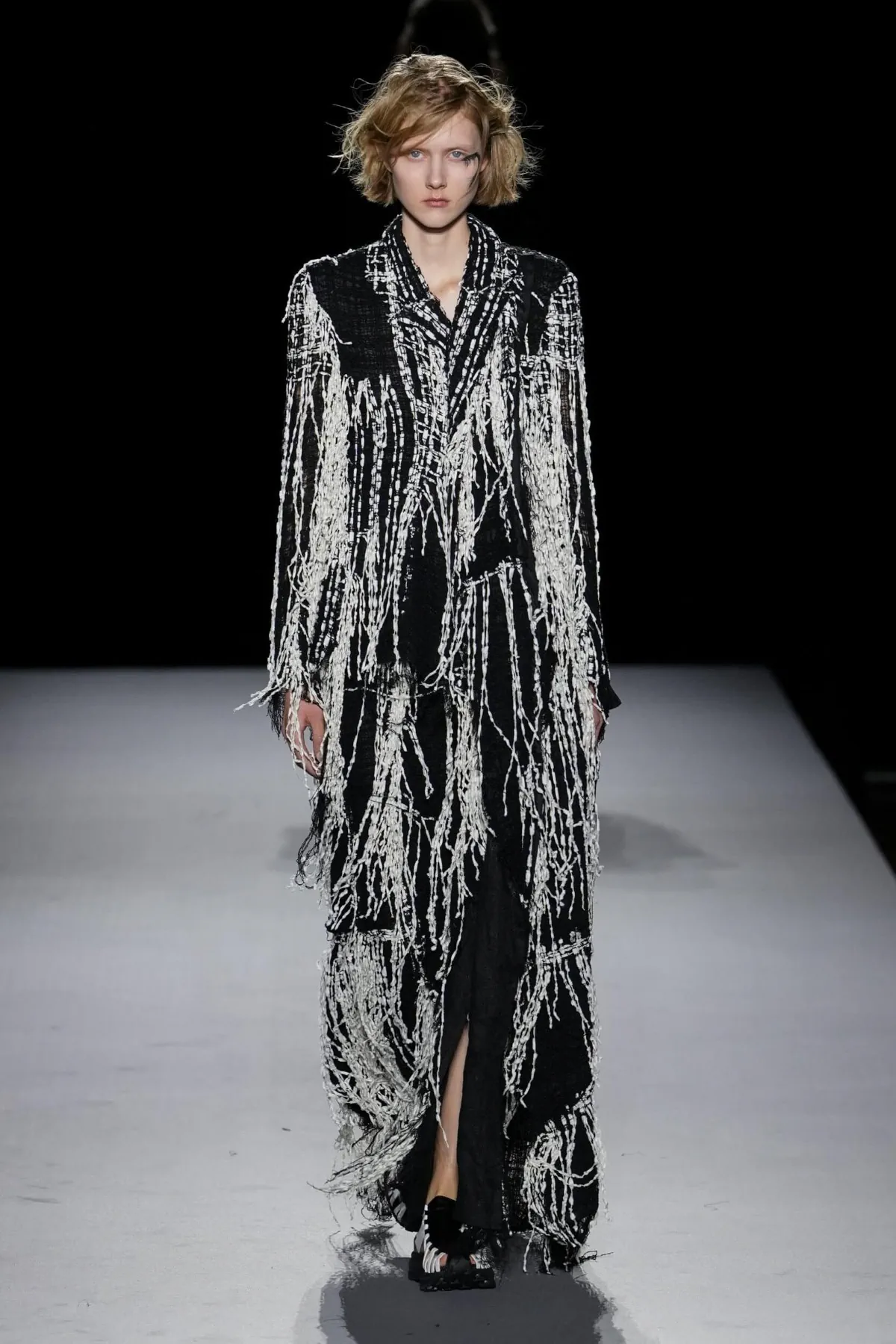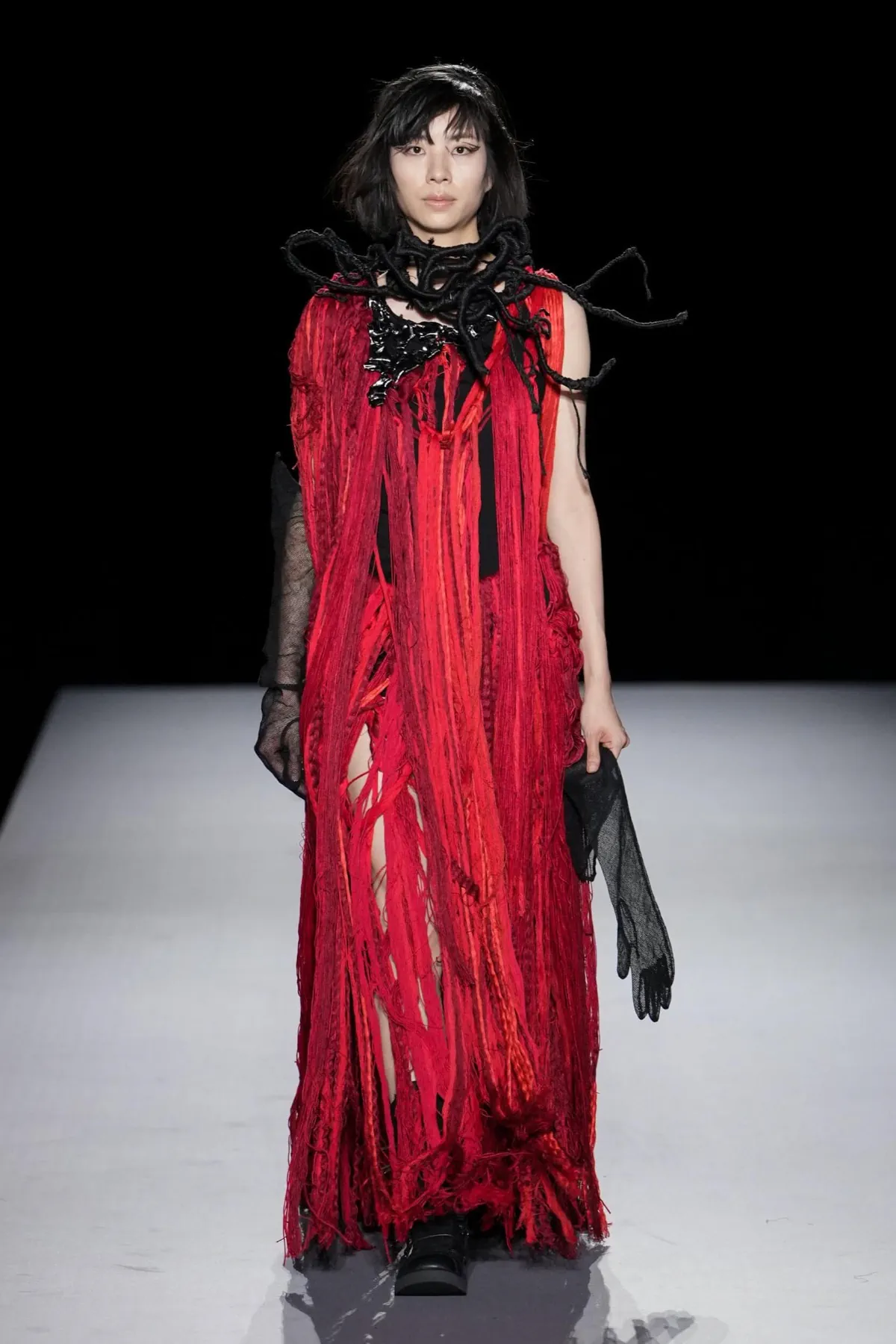

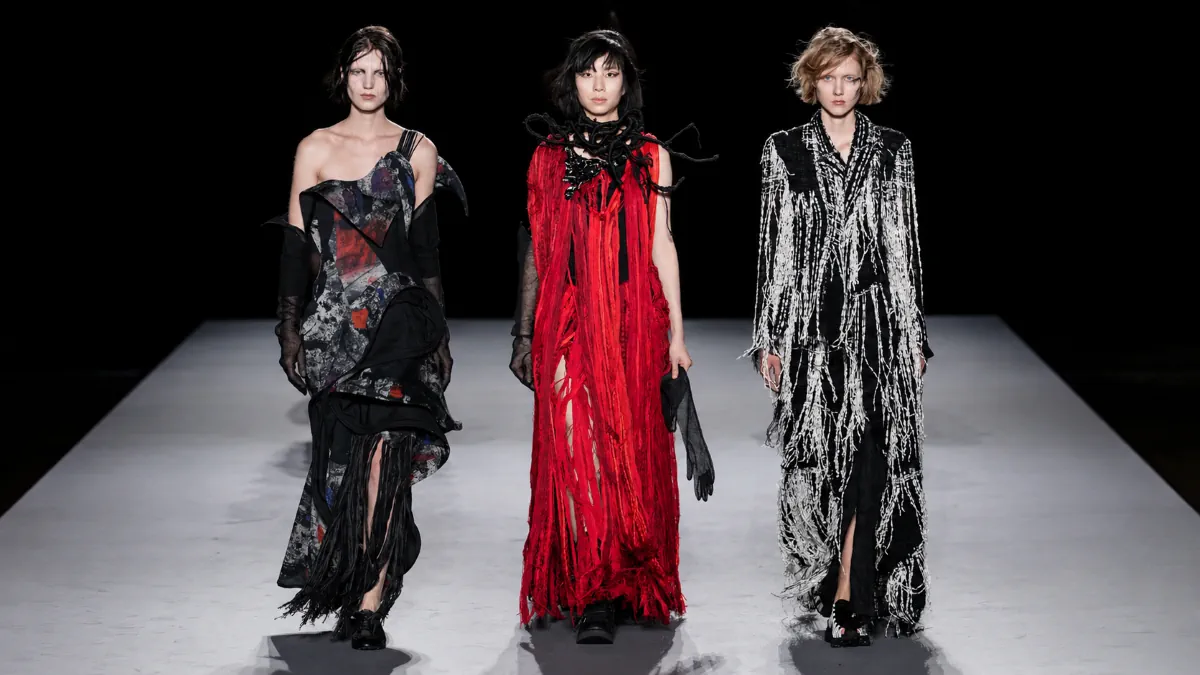
| Yohji Yamamoto Spring 2027 was presented at the Hôtel de Ville in Paris. The collection centered on fringe construction across dresses coats tailoring and knitwear. Yamamoto described the central idea as “just fringes.” Black white and red appeared prominently throughout the collection. |
For Yohji Yamamoto Spring 2027, the difference between a finished garment and an unfinished one was deliberately difficult to locate. Threads hung loose, surfaces appeared partially dismantled, and sections of fabric seemed to be caught somewhere between being assembled and coming apart.
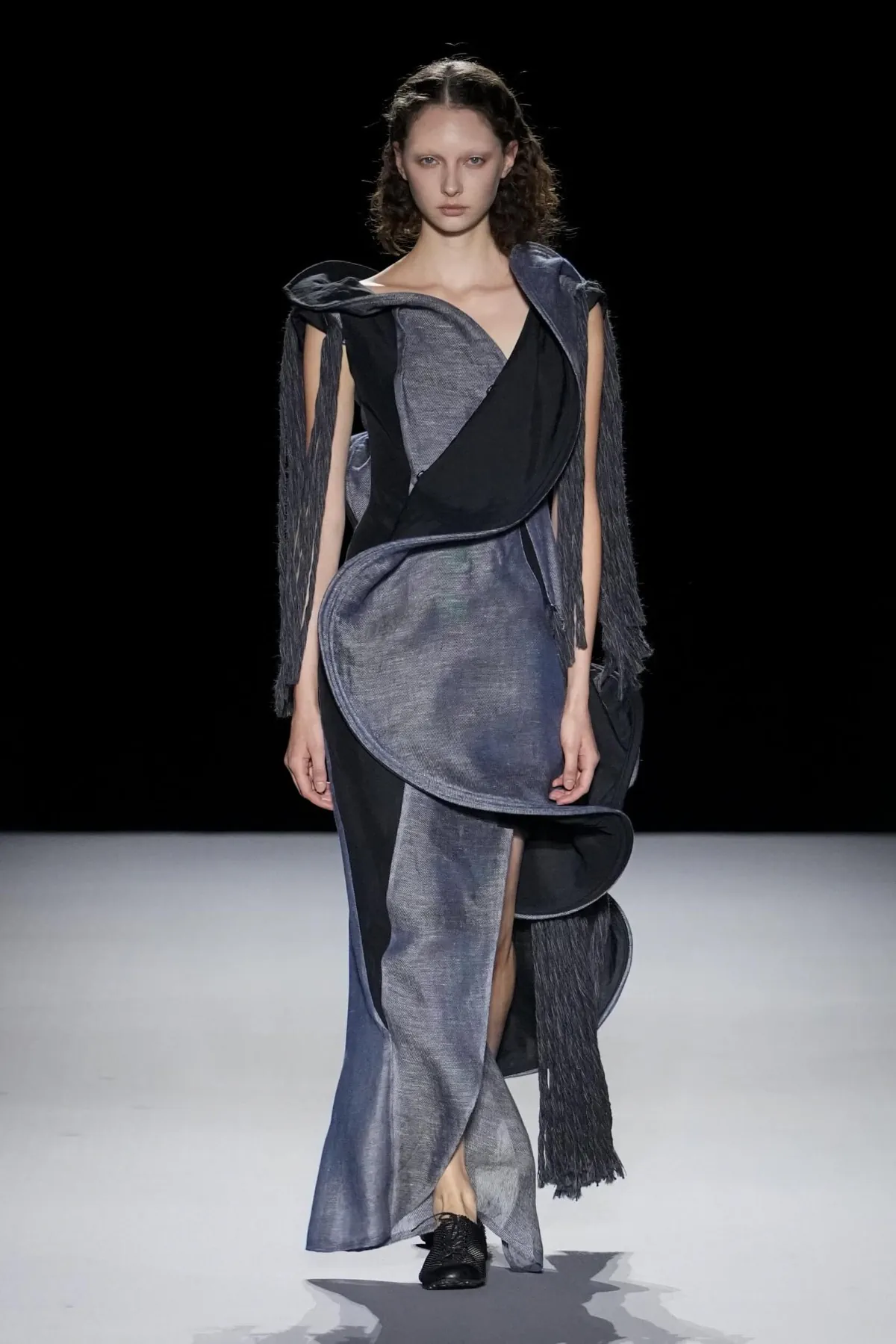
Fringe provided the clearest link between the different looks. It appeared in long strands extending from curved structures, across irregular panels and around shoulders. In other pieces, the technique became more architectural, creating open grids around the body or exposing narrow sections of skin within otherwise substantial clothing.
Yamamoto reduced the idea backstage to “just fringes,” but the collection showed how widely that single device could be developed. Rather than using fringe simply as decoration, he treated loose thread as part of the construction itself.
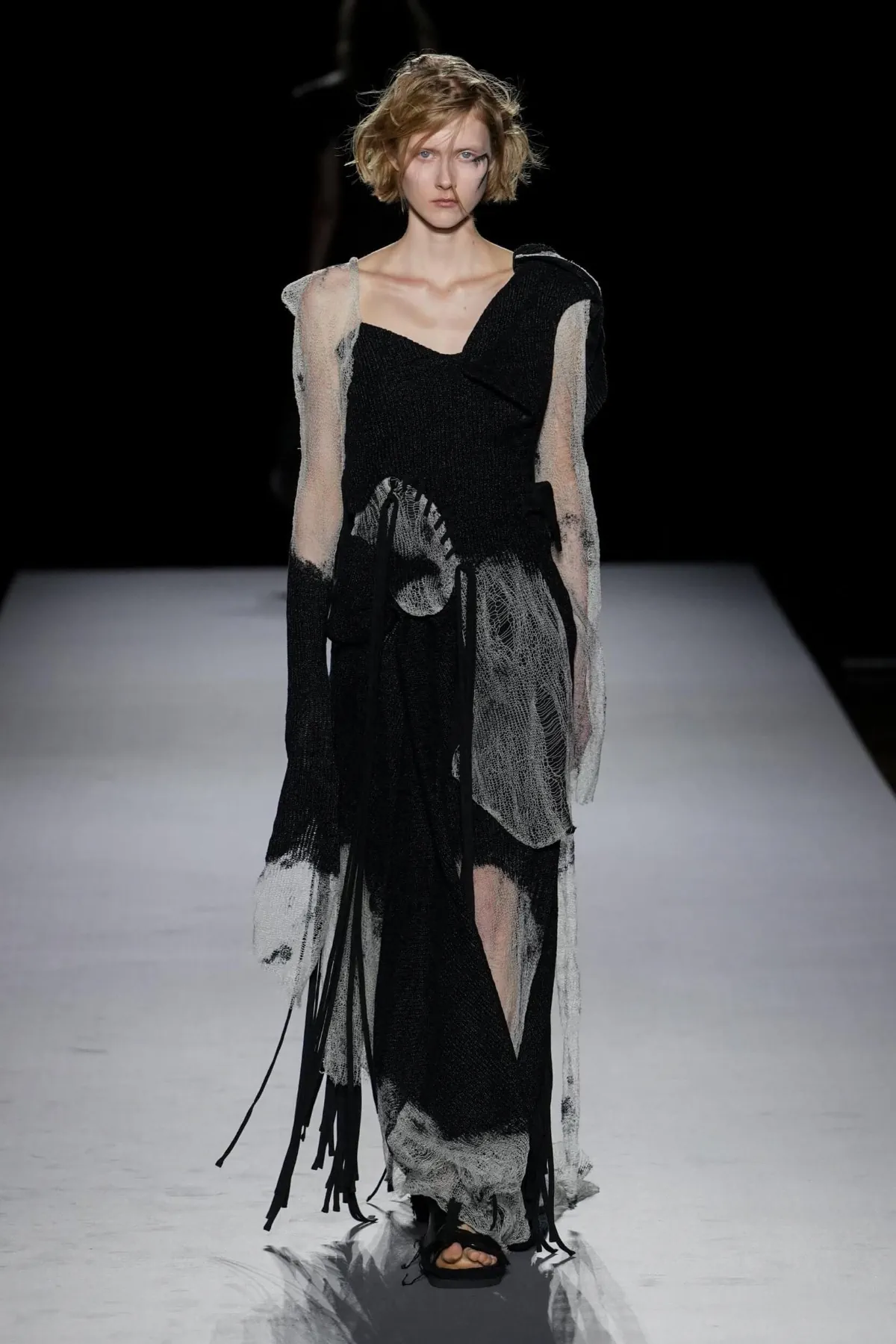
That approach was particularly visible in the coats. Some looked as though part of the woven surface had been removed, leaving vertical threads free below the remaining cloth. Knitwear followed a related direction. Dense sections gradually opened into transparent areas, allowing individual strands to remain visible instead of hiding the method by which the garment had been made.
The result placed unusual emphasis on material and labor. At a moment when much of fashion imagery can be produced or altered digitally, these clothes made physical construction easy to see. Their irregular surfaces depended on cutting, joining, knitting and controlling threads by hand.
Follow all the latest news from Fashionotography on Flipboard, or receive it directly in your inbox with Feeder.
You may also like

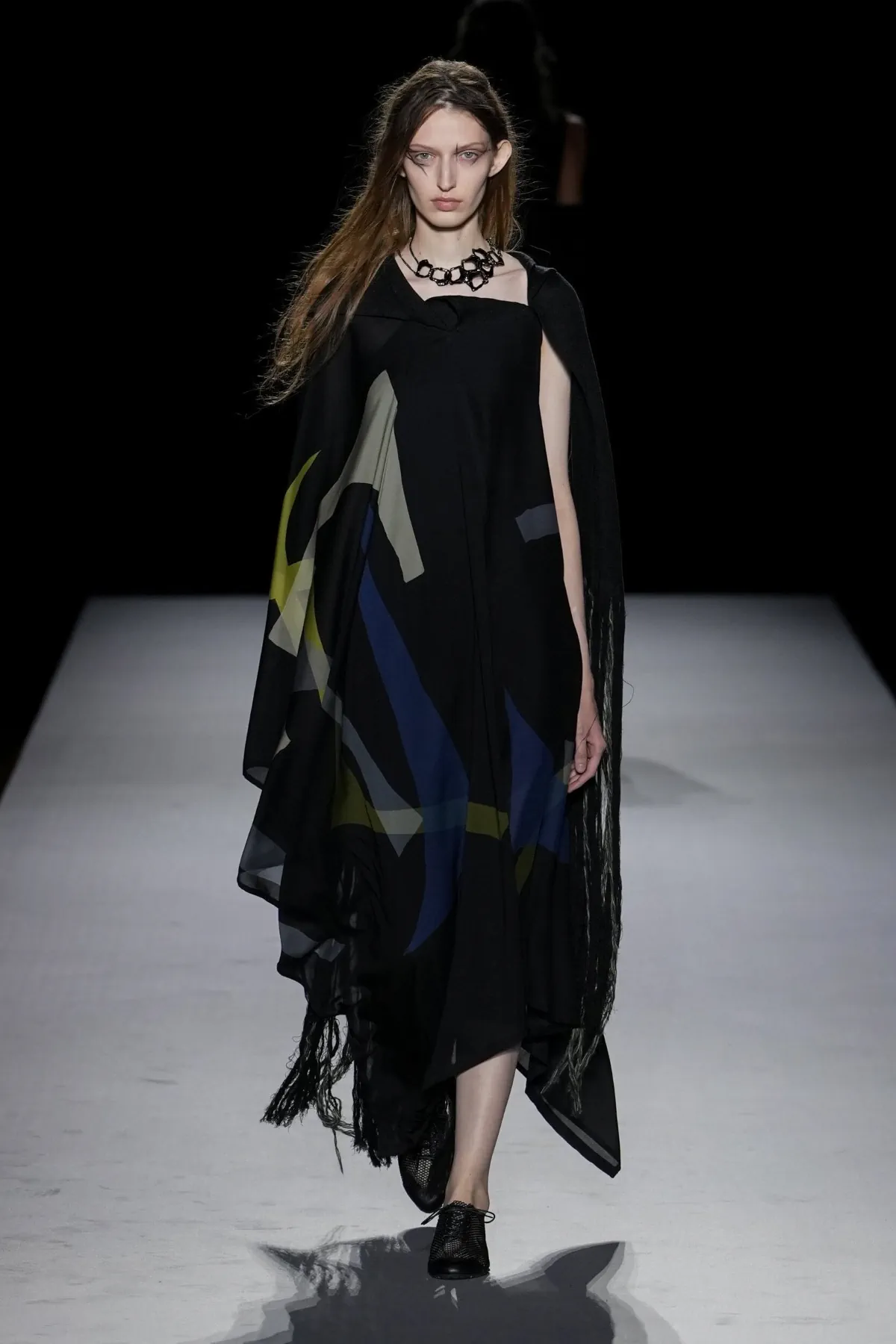
Yamamoto did not present this work as a celebration of the creative process. When asked whether he enjoyed making the collection, he replied, “All the time, process is suffering.” He also rejected the idea that completion necessarily brings satisfaction. His interest appeared to lie instead in repetition, technique and the continuous act of making.
That helps explain why Yohji Yamamoto Spring 2027 resists a simple interpretation. Was fringe becoming fabric, or was fabric being reduced to fringe? Yamamoto left that question to the viewer. The ambiguity was built into the clothes rather than explained through a fixed theme.
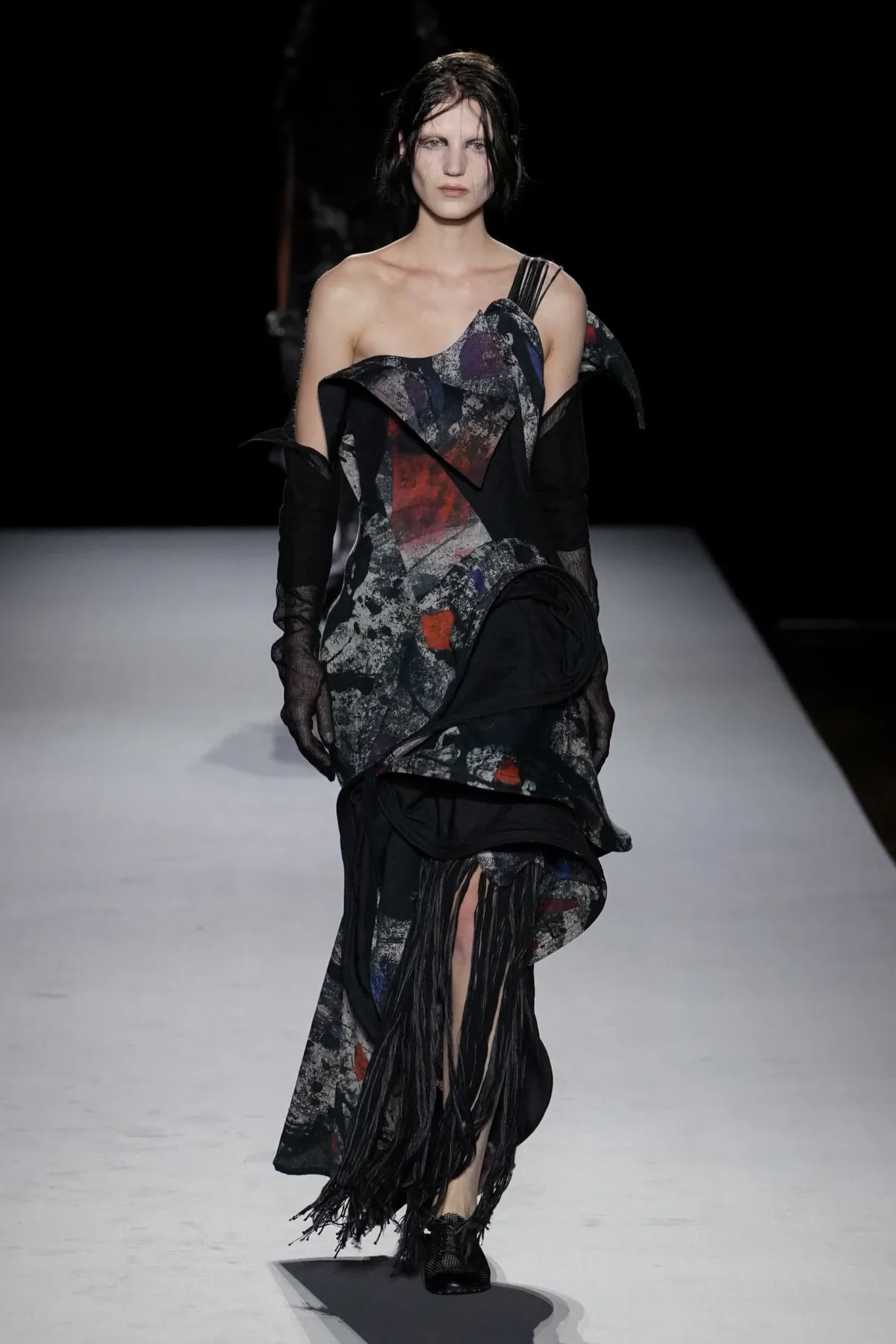
The female body remained equally important. Long dresses, open constructions and soft trailing sections followed the figure without forcing it into one standard outline. Some garments revealed the midriff, while others covered most of the body but remained sensual through transparency, texture and the way material rested against the wearer.
This distinction matters because exposure was never the collection’s only method of expressing sensuality. A fully covered look could still draw attention to shoulders, posture or proportion through the placement of threads and layers. You notice the person inside the garment rather than only the garment’s silhouette.
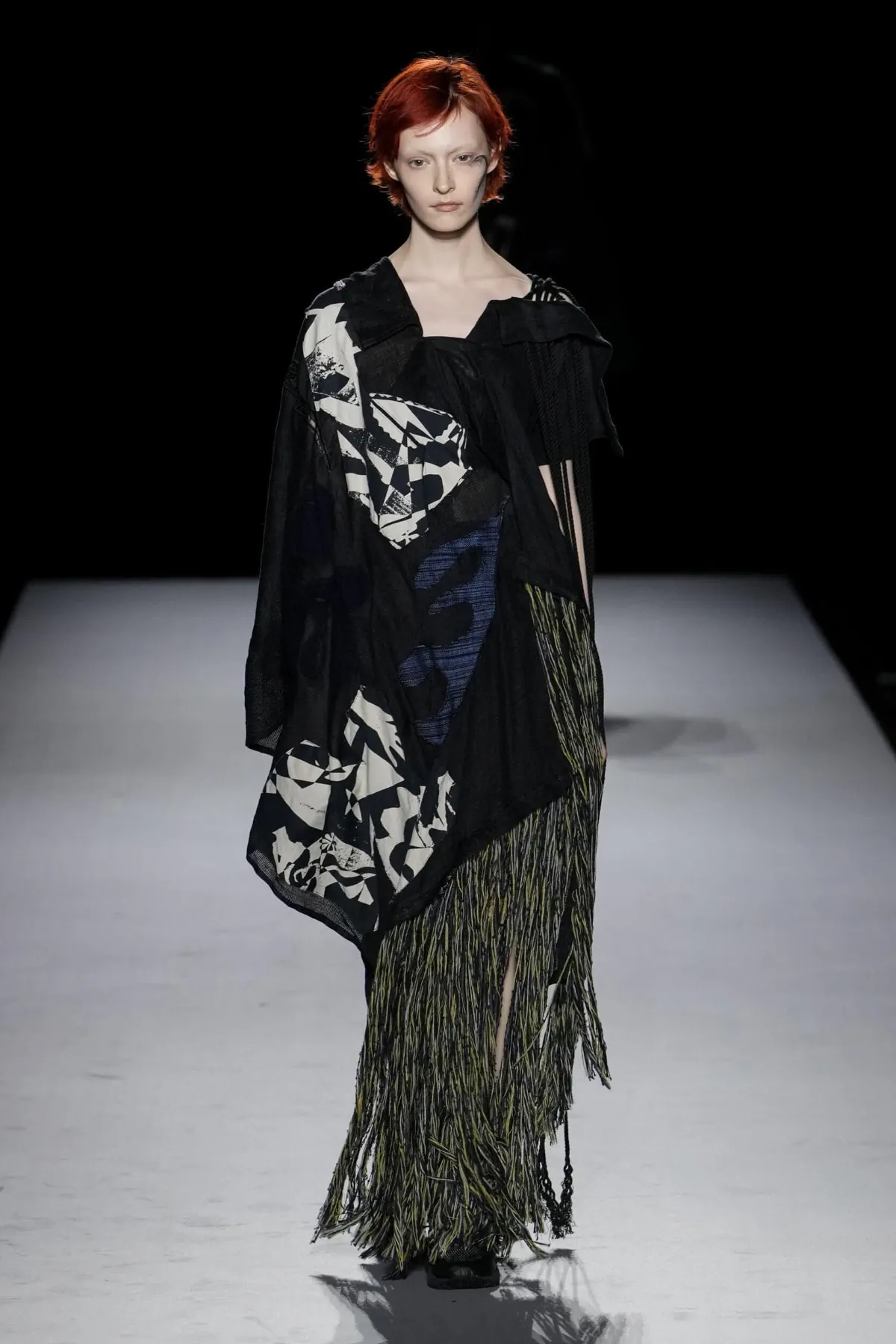
Yamamoto also spoke positively about the natural body, telling editors to look closely at their own unclothed forms and calling them beautiful. In a runway landscape where broader body representation remains inconsistent, the comment added another dimension to his focus on clothes that respond to bodies instead of prescribing a single ideal one.
The collection ultimately relied on a familiar Yamamoto principle: explanation remains secondary to observation. Its fringes, exposed structures and loosened surfaces provide enough information for the viewer to form an interpretation without being told what conclusion to reach.