

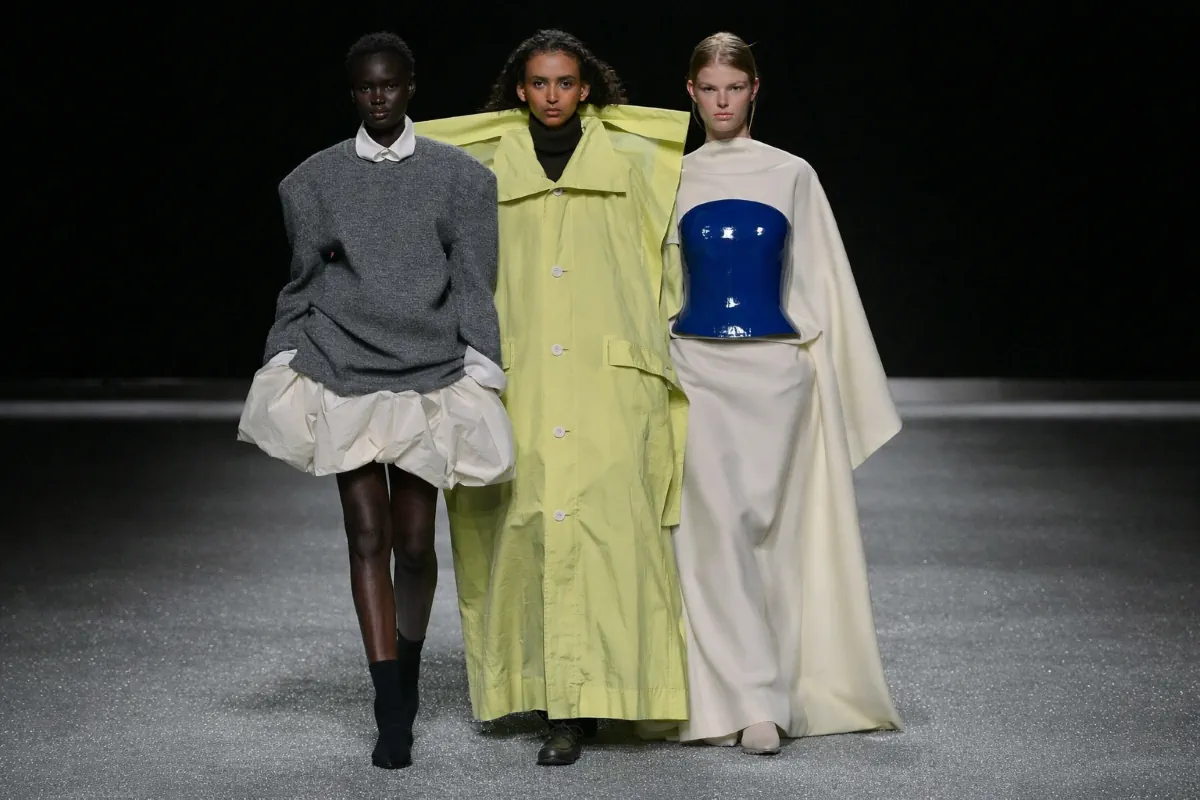
Satoshi Kondo picked up an ordinary stone on a walk and found the seed of the Issey Miyake Fall 2026 collection in its unremarkable surface. The stone had no price tag, no provenance, and no designer credit. Nature made it, and that was precisely the point. Kondo brought the stone back to the studio, had it 3D-scanned, and used its organic geometry to guide the entire season’s designs. The result was one of the quieter, more thought-provoking shows of the current runway circuit, a collection that rewards patience.
| 📌 Key Facts |
|---|
| 🪨 A simple stone inspired the entire collection, scanned in 3D and translated into garment geometry. 🧵 The concept of “undesigned clothing” guided the collection, allowing fabric to follow its own structure. 👗 Organic silhouettes and sculptural pleats defined the runway, mixing restraint with volume. 🎨 Neutral tones dominated, with accents of lemon yellow and dark orchid. 🖨️ Lacquered bustiers combined 3D printing and Kyoto washi craftsmanship. 🧠 The collection revisits Issey Miyake’s Body Works legacy while using contemporary technology. 🧥 Some pieces remain conceptual, but many explore new forms of wearable sculptural design. |

Issey Miyake’s women’s line has long treated the body as a collaborator rather than a mannequin. Fabric does not merely cover; it responds. This season, Kondo took that philosophy further by pulling back from the design process itself and asking what the cloth would do if allowed to follow its own logic. This sincere, rather than rhetorical, question produced shapes of genuine originality.
A largely restrained palette of gray, black, and deep neutral tones dominated, punctuated with sharp notes of lemon yellow and dark orchid that felt intentional rather than decorative. Knits, pleats, and finely worked textures were the materials of choice, and the resulting silhouettes ranged from streamlined and austere to unexpectedly voluminous. An oversized pinstripe jacket draped loosely over a long, matching skirt. A burgundy dress, constructed from a single rectangular piece of fabric, featured a V-neckline and a belt. These are garments that seem to have arrived at their own conclusions.

Among the most striking pieces were the lacquered bustiers, which were 3D-printed over the form of a female torso and then finished by Kyoto artisans using traditional washi paper techniques. Layers of paper, glued and lacquered to form a hard, luminous shell, sat in stark contrast to the softness of draped fabric and skin. The contrast was no accident. These pieces clearly nodded to Issey Miyake’s Body Works series from the 1980s, sharing the same preoccupation with the body as architecture, while remaining firmly rooted in present-day production methods.
Follow all the latest news from Fashionotography on Flipboard, or receive it directly in your inbox with Feeder.
You may also read

Elsewhere, trousers furled asymmetrically around the leg, stopping at unpredictable points. Hats bore irregular, pressed brims that looked more discovered than constructed. A chalk-striped suit appeared to have tailored itself convincingly. One model walked while holding the raw edges of her coat, with the bolt still attached at the hem. It was a blunt reminder that all clothing begins as cloth and that the distance between raw material and finished garment is shorter than the industry sometimes acknowledges.
Not everything will translate to a Tuesday morning. The conjoined-sleeve knit sweater and single-leg trousers are conceptual more than practical, and Kondo knows that. However, the collection’s wider appeal lies in the pieces where restraint and invention intersect: the sculptural, pleated whites that recall coral formations; the fossil-like arcs of curved fabric panels; and the coats that are so flat and papery, they seem almost two-dimensional. These are clothes with an internal logic, and wearing them means accepting some of that logic.


