



For decades, Breitling has occupied a particular and comfortable niche with its pilot’s watches, robust chronographs, slide-rule bezels, and unapologetic commitment to busy dials. The brand rarely needed to prove anything to the haute horlogerie crowd. However, something shifted in 2024 when Breitling unveiled its Calibre B19, the company’s first fully in-house perpetual calendar chronograph movement. It was housed inside a trio of limited rose gold watches made to celebrate the brand’s 140th anniversary. Those watches cost over $59,000. Most collectors could only admire them from a distance.
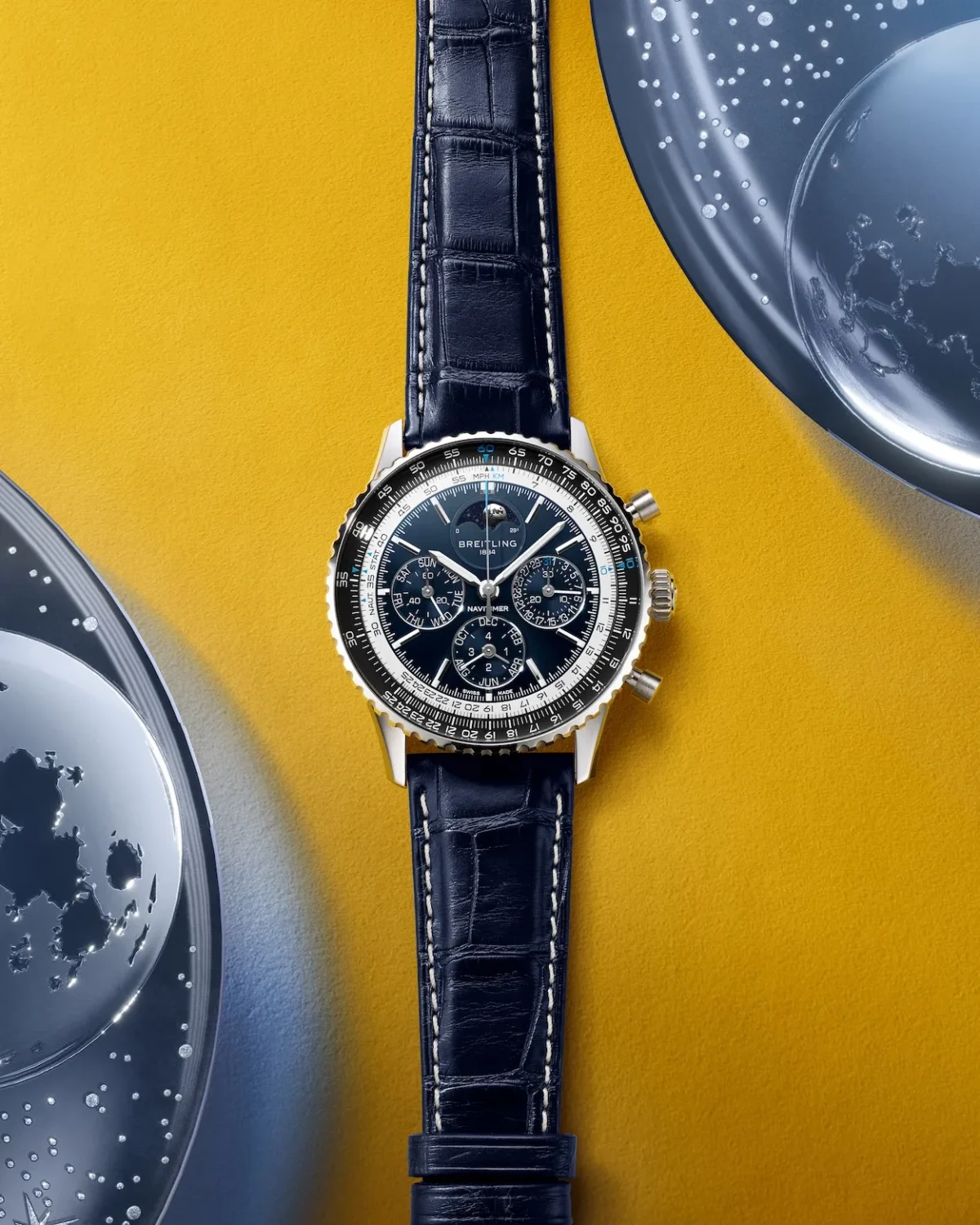
Now, in 2025, the flagship watch of Breitling’s best-known collection has become more accessible. The latest iteration, the Breitling Navitimer B19 Perpetual Calendar Chronograph, with an ice-blue dial, retains the specifications of the pink gold 140th-anniversary edition launched last year, but it trades precious metal for steel. The result is a watch that raises an interesting question: Can a Breitling comfortably compete with Patek Philippe and A. Lange & Söhne when the occasion calls for it?
The origin of the B19 movement and why it matters
To understand the B19, we must go back to August 2024. To celebrate 140 years of watchmaking, Breitling released three limited-edition watches from the Premier, Navitimer, and Chronomat families. All were equipped with a state-of-the-art, in-house movement. The movement in question, Calibre B19, was a significant achievement. Breitling had long been respected for its B01 chronograph, one of the finest integrated column-wheel chronograph movements available from a major Swiss manufacturer. The B19 builds on that foundation and goes considerably further.
It expands upon the B01 chronograph’s foundation with a perpetual calendar and moon phase display. With a frequency of 28,800 vph (4 Hz) and a power reserve of 96 hours, the B19 consists of 374 components and pairs an automatic chronograph with a perpetual calendar and a moon phase display.
The 96-hour power reserve is no afterthought. A perpetual calendar is a complication that punishes neglect; let a conventional perpetual calendar stop, and resetting it becomes a slow, stylus-assisted chore. With four days of reserve, the watch can survive a long weekend on the nightstand without requiring correction come Monday morning.
Breitling states that the Calibre B19 undergoes a 16-year aging simulation that includes 100,000 crown winds, 3,456,000 weight turns, and 60,000 shocks at 500G, among other extreme challenges. For a movement aimed at collectors who intend to wear their watches rather than display them, that kind of stress testing reads less like marketing copy and more like a promise.
Dial complexity and legibility on the Navitimer B19
The Navitimer has always been a dial that rewards patience. There is a lot going on, and the B19 version does not simplify matters. Each of the three sub-dials serves two purposes: the outer rings display calendar information, and the inner tracks display chronograph functions.
At 12 o’clock sits the moon phase indicator. Unlike the “man on the moon” decoration used for the Premier B19 Datora 42, the Navitimer shares the same classic illustrated moon as the 140^(th)-anniversary Navitimer, perhaps hinting at its origins as a scientific tool. The three sub-dials at 3, 6, and 9 o’clock handle the date, 30-minute, month and leap year, and small seconds and day functions, respectively. Surrounding all of this is the signature bidirectional slide-rule bezel. Here, it is rendered in platinum rather than steel, which introduces a subtle tonal shift without descending into ostentation.
The subdials feature circular graining within matte-finished rims, and the black slide rule provides the dial with a starkly contrasting frame. The pale blue shades play with the light, highlighting the snailed detail in the slightly recessed counters. The overall effect is one of density barely held in check – a high-wire act Breitling manages with grace, given its decades of experience with crowded dials.
One minor complaint: unlike some user-friendly perpetual calendar watches in the industry that allow adjustments through the winding crown, the B19 uses the traditional approach of additional push-pieces. Two small buttons recessed into the left side of the case serve as calendar display correctors. This is standard practice at this price level but not particularly elegant. You will need a stylus and patience if you ever let this watch stop.
| 📌 Key Facts |
|---|
| ⚙️ In-house Calibre B19 combines chronograph, perpetual calendar and moon phase ⏱️ 96-hour power reserve reduces risk of complex calendar reset 🧩 374 components integrated into a single automatic movement 🛠️ Tested through extreme durability simulations including shocks and winding cycles 🧭 Signature Navitimer slide rule bezel now executed in platinum 📏 43 mm case designed to remain wearable despite technical density 💰 Price positioned around $29,000, far below traditional competitors 📅 Calendar remains accurate without correction until 2100 if kept running |
Case proportions and wearability on the wrist
The new Navitimer B19 combines a chronograph and a perpetual calendar in a 43mm case with a stainless steel housing, measuring 49mm from lug to lug and 15mm in thickness. Those numbers read large on paper. However, on the wrist, the Navitimer’s proportions tend to be more forgiving than the specifications suggest. This is partly because the round case carries its diameter well and partly because the watch’s visual weight is pulled inward by the busy dial rather than outward toward the edges.
The 4Hz caliber is fairly slender for the amount of information it packs in. The uncased height is 8.53 mm, and the watch boasts an impressive 96-hour power reserve. Achieving a perpetual calendar chronograph with a total case height under 15 mm is challenging, and Breitling deserves credit for making the watch wearable.
The platinum bezel deserves a mention. Platinum is not typically associated with sporty tool watches. It scratches more easily than steel, has a different visual weight, and signals a particular kind of collector who appreciates the material for its density and rarity rather than its practicality. Whether it belongs on a Navitimer is a fair question. What it indisputably achieves, however, is a quiet visual contrast against the ice-blue dial that steel alone could not provide.
Follow all the latest news from Fashionotography on Flipboard, or receive it directly in your inbox with Feeder.
You may also read

Positioning against Swiss high horology competitors
The perpetual calendar chronograph is one of the rarest combinations in mechanical watchmaking. Most such watches tend to be considerably more expensive. The new B19 retains the same basic specifications as its precious metal counterpart while keeping the price under $30,000. For context, a Patek Philippe perpetual calendar chronograph (the reference 5270) retails for approximately $150,000. A comparable piece from A. Lange & Söhne costs significantly more. Even at $29,000, the Breitling is not an impulse purchase. However, as an entry point into the rare category of mechanical complications, it offers exceptional value.
A QP chronograph is a rare find, and Patek Philippe is perhaps the best-known maker in this category – not bad company for Breitling to be in.
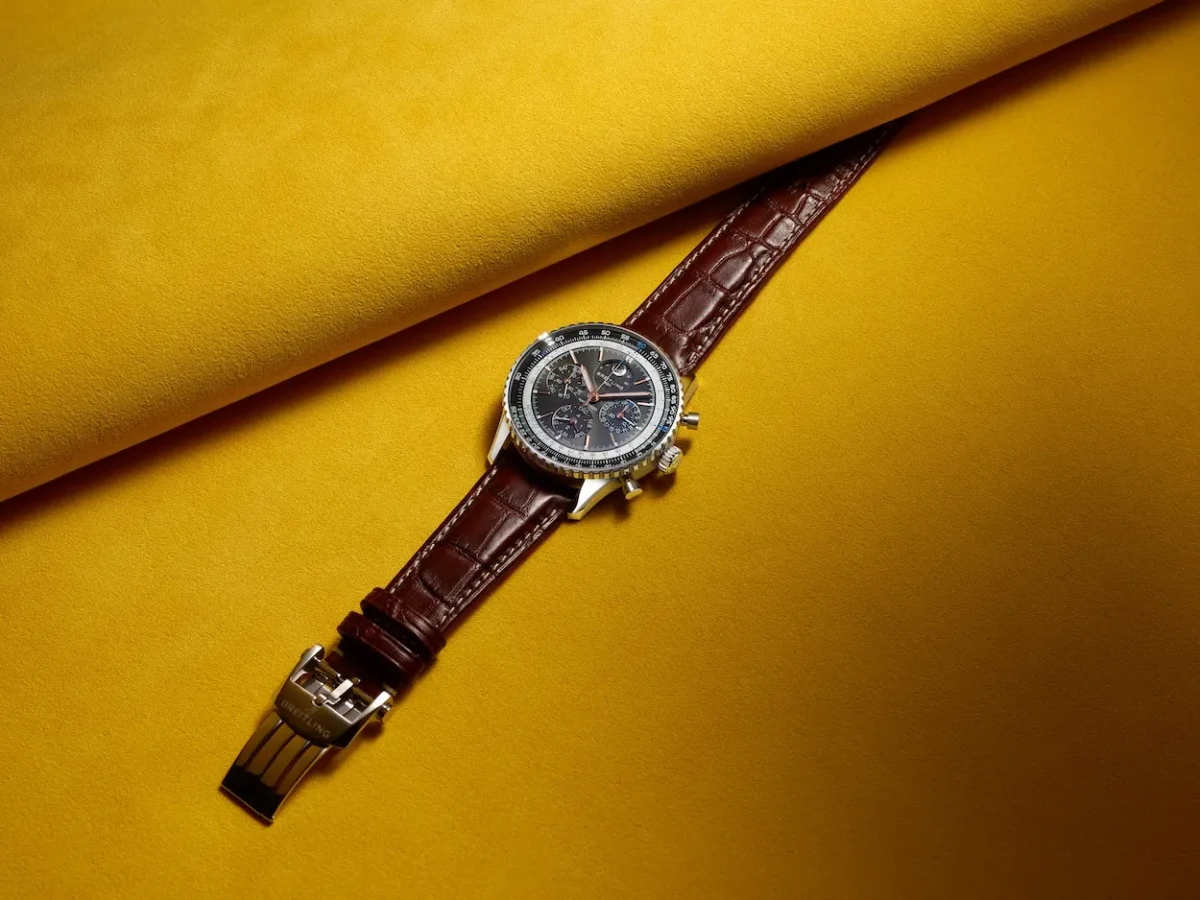
The watch comes with either a black alligator strap with contrasting white stitching and a stainless steel folding buckle or a seven-row stainless steel bracelet with a butterfly clasp. The bracelet version costs $500 more at $29,500, which is an almost negligible premium compared to this highly complex model’s sticker price.

Strengths and limits of Breitling’s proposition
More than anything else, the Breitling Navitimer B01 Perpetual Calendar Chronograph is a proof of concept: Breitling can manufacture a perpetual calendar movement. They can make it well. They can also put it inside their most recognizable watch without the whole thing falling apart aesthetically.
Does the watch have the finishing of a Patek Philippe? No. Does the dial achieve the architectural clarity of a Lange? Not quite. However, it does something those watches do not: it makes the perpetual calendar chronograph accessible to those who might never have considered it. Assuming the watch is kept fully wound, the date will not require manual correction until the year 2100. For a $29,000 watch, that is a genuinely extraordinary promise.