


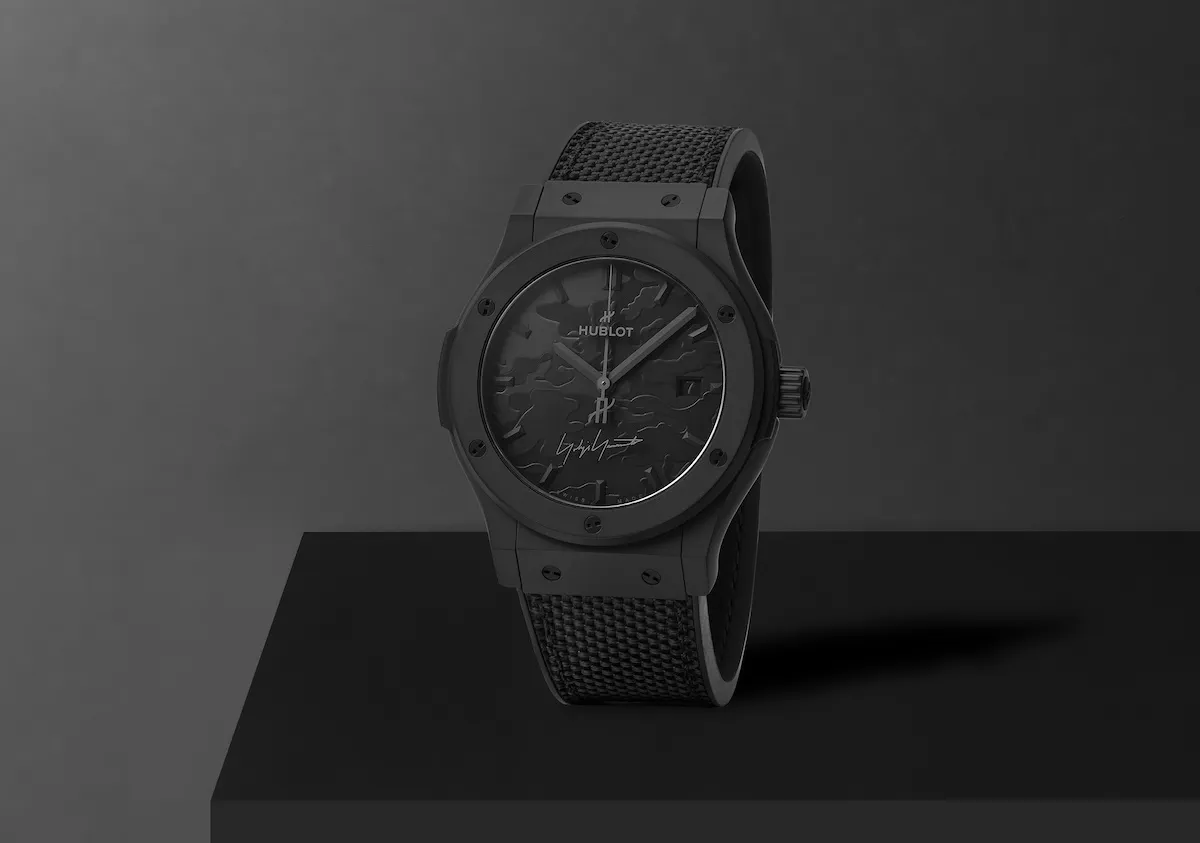
In a world of loud collaborations, the Classic Fusion Yohji Yamamoto All Black Camo chooses restraint. This limited edition of 300 pieces explores black not as a color, but as a material, where texture, silhouette and light quietly define luxury.
The 42mm case sits comfortably on your wrist, despite its all-ceramic construction. Microblasted black ceramic encases the HUB1110 self-winding movement, creating a surface that absorbs light rather than reflecting it. The finish feels almost velvety when you run your finger across the bezel. However, I wouldn’t recommend doing that too often. Ceramic scratches are permanent, and at $12,100, you’ll want this piece to look pristine.
| 📌 Key Facts |
|---|
| 🖤 Limited Edition: 300 pieces worldwide ⌚ Case: 42 mm microblasted black ceramic 🎨 Dial: Textured monochrome camouflage (black-on-black) ⚙️ Movement: HUB1110 automatic, 48-hour power reserve 💧 Water Resistance: 5 ATM / 50 meters 💰 Retail Price: USD 12,100 |

How black-on-black camouflage redefines the dial
The dial caught me off guard when I first pulled the watch from its packaging. Yohji Yamamoto’s signature camouflage pattern appears not through color variation, but through subtle texture shifts. Black on black and gray on black, the pattern reveals itself only when light hits the dial at specific angles. This effect reminds me of high-end Japanese denim, where quality is shown through craftsmanship rather than obvious branding.
Julien Tornare, the CEO of Hublot, captured the philosophy behind this collaboration when he said, “For Yohji Yamamoto, black reveals what truly matters. It purifies form, allowing silhouette and texture to speak. At Hublot, we treat black as a living material, sculpting, layering, and folding it so that each surface interacts differently with light. This project marks our very first collaboration on a Classic Fusion model, and together, we share the belief that luxury is not what shines, but what endures.”
This quote captures something fundamental. Both Hublot and Yamamoto built their reputations by challenging conventions. Hublot combined gold with rubber in 1980, a time when the Swiss watch industry considered such pairings sacrilegious. Yamamoto debuted his first Paris runway show in 1981 with all-black silhouettes that critics initially dismissed. Now, 45 years later, both approaches seem prescient rather than rebellious.
Follow all the latest news from Fashionotography on Flipboard, or receive it directly in your inbox with Feeder.
You might also read

HUB1110 movement: purposefully understated mechanics
The HUB1110 caliber ticks away beneath a smoked sapphire caseback and offers approximately 48 hours of power reserve. With 177 components and 25 jewels beating at 28,800 vibrations per hour, the movement performs as expected from a modern Hublot caliber. Nothing groundbreaking happens mechanically here, but that seems intentional. The skeletonized rotor, visible through the caseback, maintains the monochrome aesthetic even where most people will never look.
The watch is water resistant up to 5 ATM, or about 50 meters. You can wear this watch while washing your hands or getting caught in the rain, but swimming is probably pushing the boundaries of what is advisable. The 10.4 mm case thickness allows the watch to slide under shirt cuffs without catching. However, the ceramic construction adds noticeable weight compared to titanium or steel alternatives.
Six H-shaped, black-plated, polished titanium screws secure the bezel to the case. These screws reference the porthole design that launched Hublot four decades ago, connecting this contemporary piece to the brand’s founding innovation. The screws also provide visual rhythm around the dial, breaking up what would otherwise be an unrelenting expanse of black ceramic.

Design codes that connect fashion and watchmaking
The strap deserves particular attention. Combining black fabric with black rubber, the strap echoes Yamamoto’s approach to materials while meeting Hublot’s technical standards. The fabric portion feels soft against the skin, and the rubber provides durability and water resistance. A black-plated steel deployant clasp secures the band, clicking shut with satisfying precision.
Yohji Yamamoto himself offered insight into his design philosophy, affirming that “black is modest and arrogant at the same time.” That duality is evident here. This watch doesn’t announce itself from across a room. No gold gleams, no diamonds catch the light, and no bright dial colors demand attention. Yet, the design exudes confidence. The person wearing this piece doesn’t need external validation.

Who the Classic Fusion Yohji Yamamoto All Black Camo is really for
I keep coming back to how specific this collaboration feels. The Classic Fusion Yohji Yamamoto All Black Camo isn’t for everyone, and I suspect that’s how both Hublot and Yamamoto prefer it. If you want a watch that sparks conversation at dinner parties, look elsewhere. If you want a watch that photographs well for social media, the monochrome palette might disappoint you.
However, if you appreciate subtlety and understand why Yamamoto’s anti-fashion stance revolutionized clothing, and prefer watches that reward close examination rather than distant admiration, then this piece makes sense. The limited production of 300 pieces ensures scarcity without feeling artificially constrained. You could probably acquire one by contacting the right Hublot boutique.
Priced at $12,100 (€12,000, £9,900, or CHF 10,500, depending on your market), it sits below Hublot’s more complicated offerings but above entry-level Classic Fusion models. You’re paying for the collaboration, limited production, and unique aesthetic. Whether or not you find that to be a good value depends entirely on how much you appreciate what Yamamoto brings to watchmaking.