


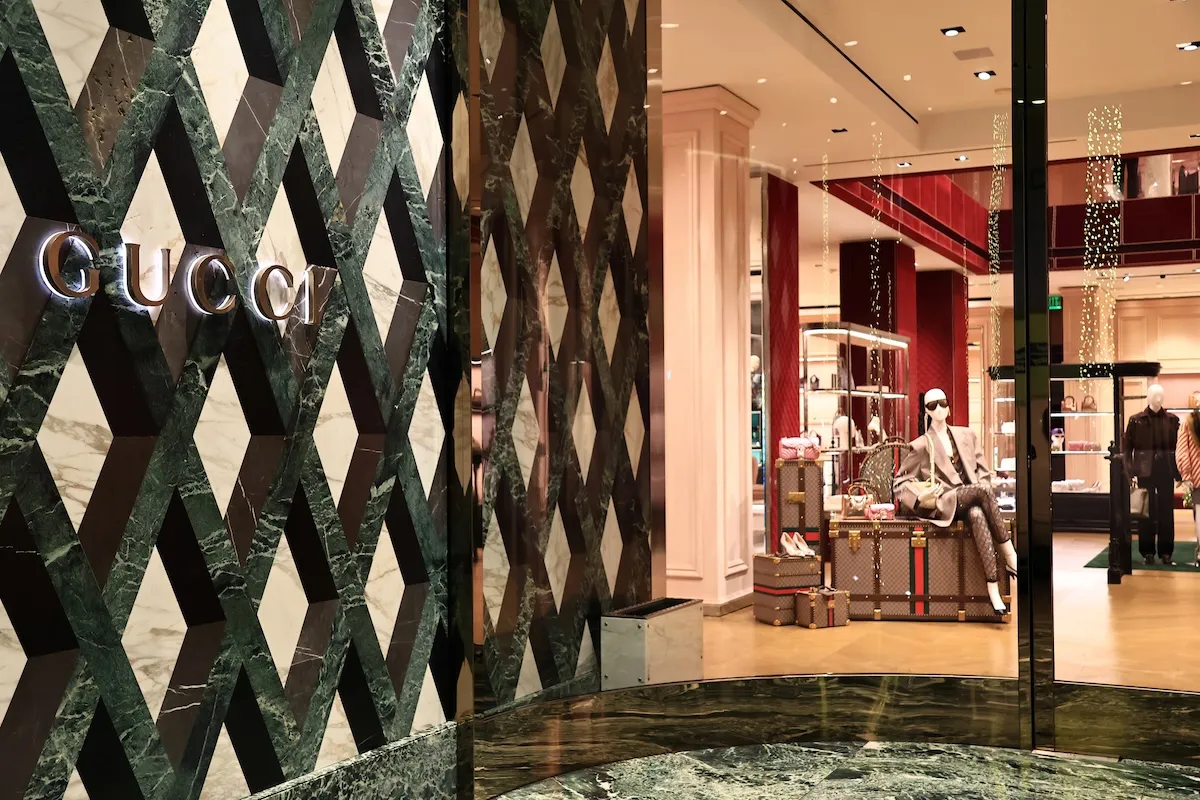
Kering ended 2025 with a net loss of 29 million euros, a stark reversal from the 1.02 billion euro profit the French luxury conglomerate posted just one year earlier. The owner of Gucci, Saint Laurent, and Balenciaga revealed that fourth-quarter revenue dropped nine percent to 3.91 billion euros. However, the figures exceeded analysts’ predictions.
These numbers tell the story of a company in transition, grappling with restructuring costs and an unforgiving luxury market. Chief Executive Officer Luca de Meo, the former Renault executive who took the helm in September, has moved quickly to transform Kering. His approach has been surgical. Kering eliminated 925 million euros in operating expenses in 2025, closed 75 stores, and plans to shutter another 100 locations this year. More closures remain under consideration.
| 📌 Key Facts |
|---|
| 📉 Net result: €29 million loss in 2025 (vs. €1.02bn profit in 2024) 🏬 Store closures: 75 closed in 2025, 100 more planned ✂️ Cost savings: €925 million in operating expenses cut 👗 Gucci weight: 59% of group operating profit 💼 CEO: Luca de Meo (since September 2025) 💸 Net debt: Reduced to €8.04bn from €10.5bn 📅 Next milestone: Capital Markets Day, April 16 (Florence) |
Gucci’s central role in Kering’s turnaround strategy
Gucci remains the engine driving Kering’s fortunes, accounting for 59 percent of the group’s operating profit last year. The brand’s fourth-quarter performance showed an organic revenue decline of 10 percent, which is a slight improvement over the 11 percent drop that analysts had forecast. This sequential improvement suggests that Demna Gvasalia’s appointment as creative director earlier in the year may be starting to register with consumers.
Gvasalia officially joined Gucci in July, after spending years leading Balenciaga, another Kering brand, where he built a reputation for provocative designs and cultural relevance. Kering’s decision to hire him represented a calculated bet that he could revitalize its most important asset. Whether that gamble will pay off remains to be seen, but the early signs point toward stabilization rather than dramatic recovery.
How Kering’s other brands are holding up
Other brands within the Kering portfolio showed modest gains during the fourth quarter. Saint Laurent held steady with flat organic sales, while the “other houses” division reported a 3 percent increase. Bottega Veneta posted a 3 percent rise in comparable sales. The eyewear and corporate division grew by two percent.
These figures were restated to account for the sale of Kering Beauté to L’Oréal, a transaction expected to close in the first half of this year. The beauty division’s activities have been reclassified as discontinued operations, a technical accounting move that removes those results from the company’s ongoing business performance.
Recurring operating profit fell 33 percent to 1.63 billion euros for the full year, with the recurring operating margin sliding to 11.1 percent from 14.5 percent in 2023. These numbers reflect the impact of optimization and restructuring measures that resulted in a net loss.
Follow all the latest news from Fashionotography on Flipboard, or receive it directly in your inbox with Feeder.
You may also read

Cost cuts, store closures and debt reduction explained
De Meo’s cost-cutting campaign extended beyond store closures and expense reductions. Kering sold key real estate assets, reducing net debt from 10.5 billion euros the previous year to 8.04 billion euros. This deleveraging is significant for a company navigating choppy waters in the luxury sector.
During a webcast with analysts and reporters, the CEO struck a defiant tone. “Of course, 2025 was not the year we wanted,” De Meo acknowledged. He described the current revenue level as “the low point of the cycle and the starting point of our rebound.”
De Meo said he spends weekends visiting stores, meeting with team members, and speaking with clients. “There is energy coming back,” he insisted. “Our products are reconnecting with our clients. The momentum is real – early and fragile, but real – and I guarantee we will build on it.”
What’s next for Kering after a turbulent 2025
Kering’s performance during the fourth quarter improved from the third quarter, when group revenue fell 10 percent at reported exchange rates. This deceleration of the decline offers hope that the worst may be behind the company.
De Meo plans to present his strategic roadmap at a Capital Markets Day in Florence on April 16th. The event will give investors and industry observers their first comprehensive look at how the CEO envisions Kering’s future. Until then, the luxury conglomerate is in a position familiar to troubled companies, promising better days ahead while managing the difficult present.
The broader luxury market provides little comfort: LVMH Moët Hennessy Louis Vuitton, Kering’s larger rival, reported a 3 percent decline in organic sales for its fashion and leather goods division during the fourth quarter. Hermès International, the industry’s most resilient performer, was scheduled to report its fourth-quarter results shortly after Kering’s announcement.