


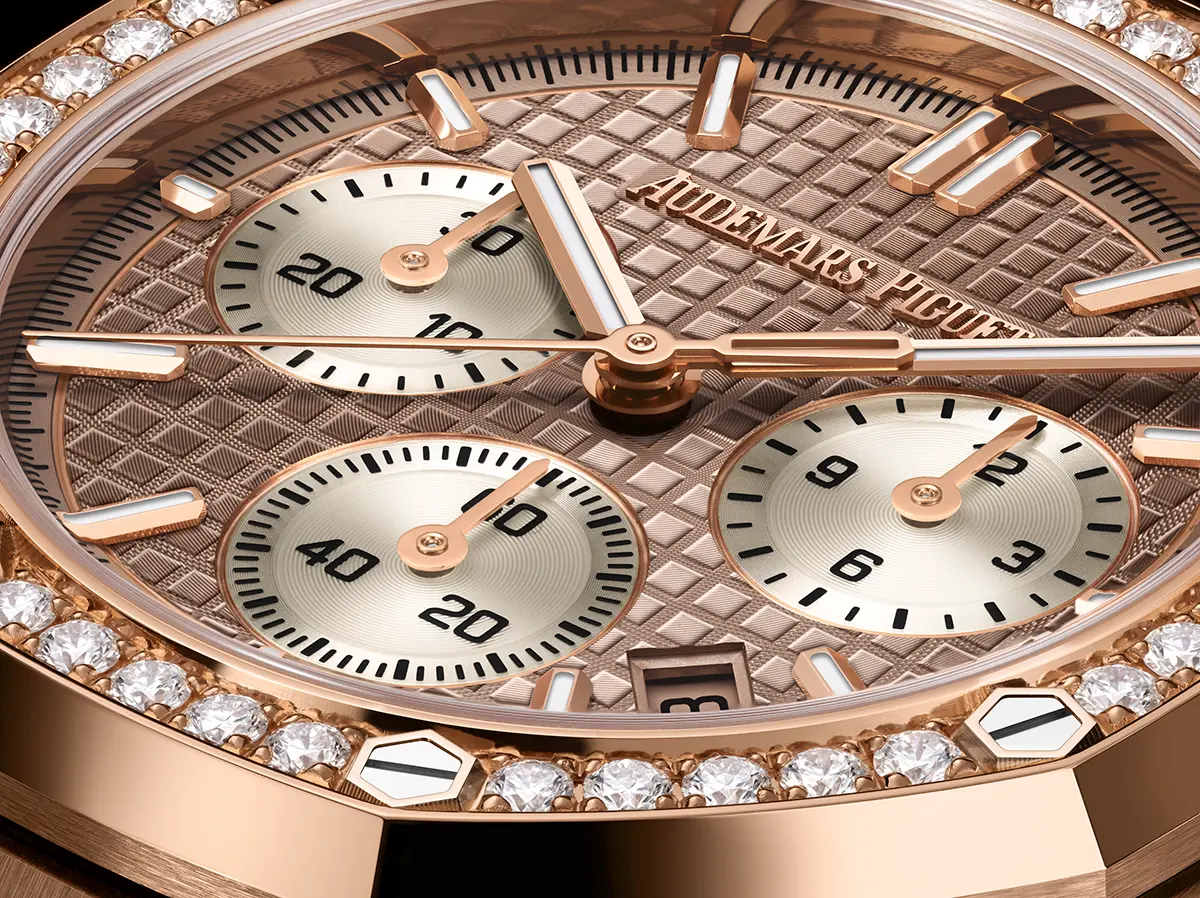
The Audemars Piguet Royal Oak Chronograph 38 mm has received what might be its most significant update since the reference debuted in 2019. After nearly three decades of relying on Calibre 2385, the manufacture has developed an entirely new selfwinding chronograph movement from the ground up. Five years of development have culminated in Calibre 6401, and the result is now housed within three new references that mark a technical and aesthetic departure for this size category.
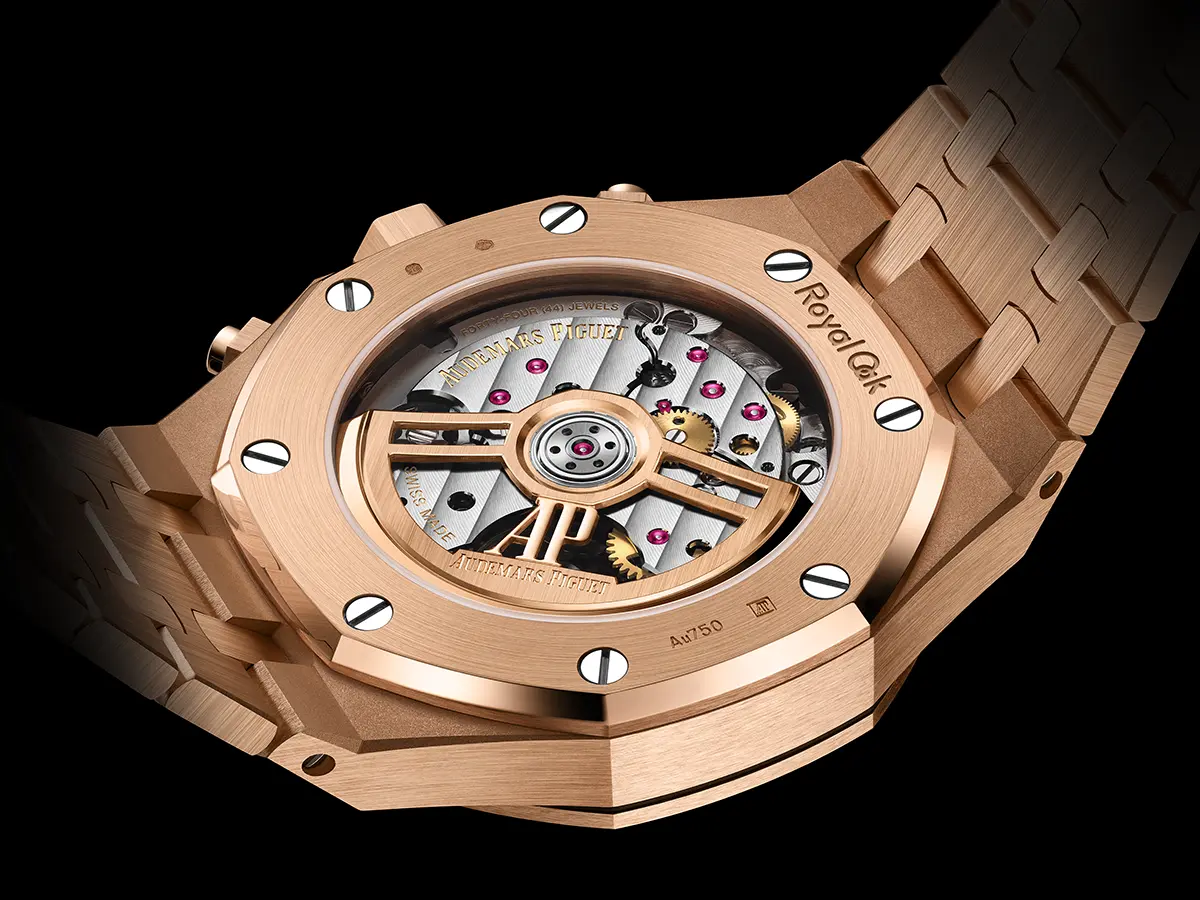
What makes this update particularly noteworthy is not just the new movement, but what comes with it. For the first time, the Royal Oak Chronograph 38 mm features a sapphire caseback, offering a window into the mechanism that drives one of the most recognizable chronograph designs in contemporary watchmaking. This alone represents a shift in how Audemars Piguet approaches transparency – quite literally – in a line that has historically kept its mechanics concealed.
| 📌 Key Facts |
|---|
| 🕰️ New movement: Selfwinding integrated chronograph Calibre 6401 ⚙️ Development time: 5 years 🔋 Power reserve: 55 hours ⏱️ Frequency: 4 Hz 🧭 Chronograph layout: Minutes at 9 o’clock, hours at 3 o’clock 🔍 Caseback: Sapphire display back (first time on this model) 📐 Case size: 38 mm × 11.1 mm 💎 Launch references: Steel, pink gold, pink gold with diamond bezel |

Calibre 6401: Five years to replace Audemars Piguet’s chronograph benchmark
Calibre 2385 was introduced in 1997 and quickly became the foundation for much of Audemars Piguet’s chronograph production. For almost thirty years, it powered countless Royal Oak and Royal Oak Offshore references, proving itself reliable and robust. Replacing such a longstanding caliber was never going to be a small undertaking, and the five-year development timeline for Calibre 6401 reflects that reality.
Both movements share fundamental DNA – they are integrated column wheel chronographs with vertical clutch systems. But Audemars Piguet has reworked the clutch mechanism entirely, filing a patent for the new design. The stated goal was to reduce complexity, eliminate unnecessary components, and minimize internal play. Fewer parts theoretically mean fewer potential points of failure, and tighter tolerances should translate to more consistent performance over time.
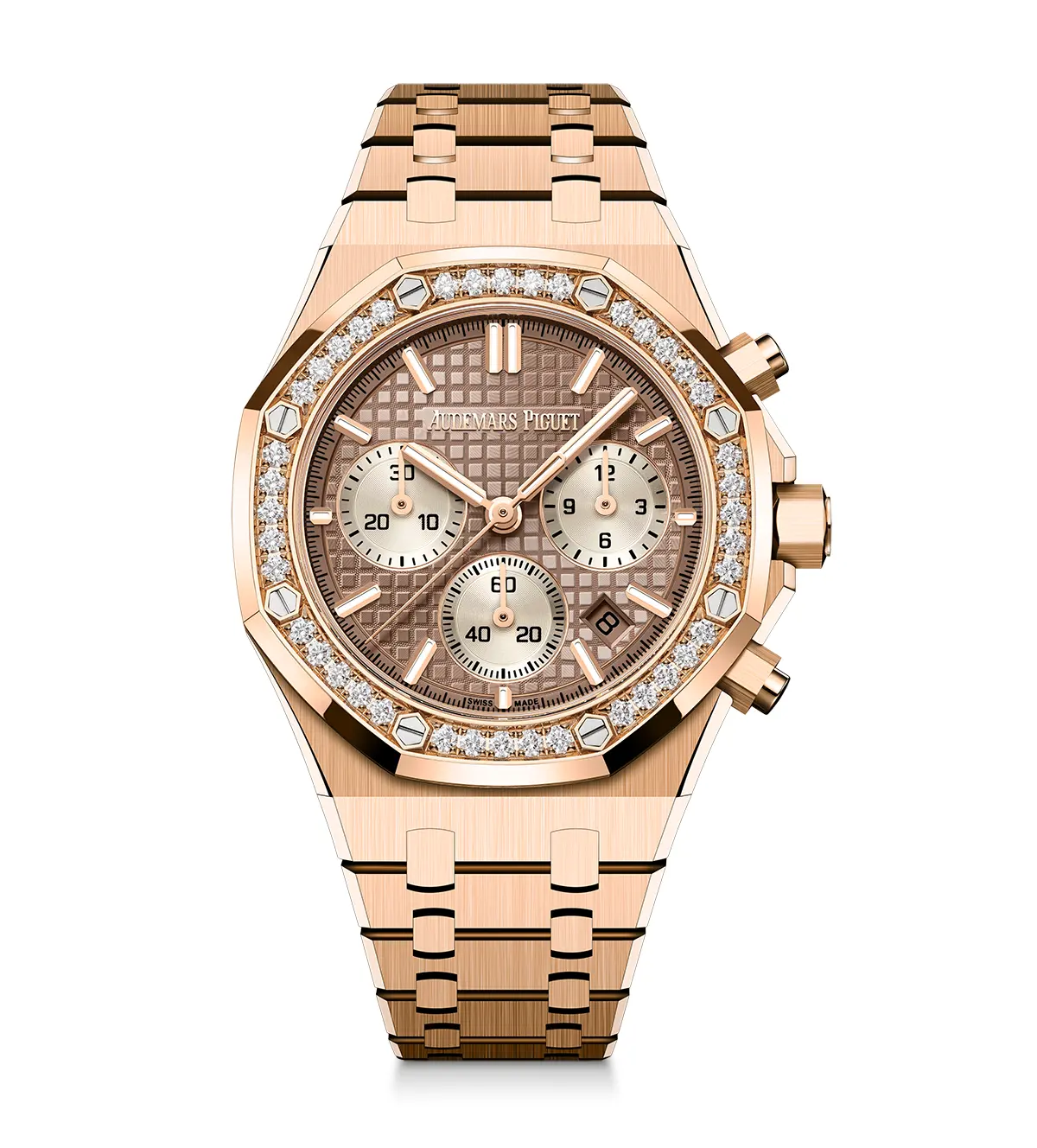
The practical benefit, according to the manufacture, is a lighter push-piece action. Activating the chronograph now requires less pressure, which should make the watch more pleasant to use. Whether that difference is perceptible to the average wearer remains to be seen, but the effort to refine the tactile experience is notable.
Power reserve has also improved. Calibre 6401 delivers 55 hours of runtime, a modest but welcome increase over its predecessor. The movement maintains a 4 Hz beat rate and incorporates a simple instant-jump date function. Counter placement has been reimagined for improved legibility, with the minute counter now positioned at 9 o’clock and the hour counter at 3 o’clock, creating better visual symmetry across the dial.
Follow all the latest news from Fashionotography on Flipboard, or receive it directly in your inbox with Feeder.
You may also read

What changes on the dial and case
Audemars Piguet has kept the case dimensions unchanged. The new references retain the 38 mm diameter and 11.1 mm thickness of the outgoing model, which means wearability remains consistent. But the sapphire caseback is a departure from tradition. Through it, you can see the movement’s openworked monobloc rotor, along with Côtes de Genève striping and alternating satin brushing and polished chamfers on the bridges.
The dial layout has been adjusted to accommodate the new movement architecture. Most obviously, the date aperture has been repositioned. Previously sitting slightly off-center, it now appears more centrally located between the 4 and 5 o’clock markers. The counter configuration has also been inverted compared to Calibre 2385, which is immediately apparent when comparing the two side by side.
Three references launch with the new caliber. The first is a stainless steel model with the “Bleu Nuit, Nuage 50” Grande Tapisserie dial – a continuation of the blue-dialed Royal Oak tradition that needs little explanation. This version retains the familiar aesthetic language of the line, with the addition of the display caseback and the adjusted date window.
The second reference features an 18-carat pink gold case paired with a dark grey dial and beige counters. The warm gold contrasts against the cool grey, while pink gold hands and hour markers create a cohesive palette. The interplay between these tones adds depth without overwhelming the dial’s architecture.
The third option combines an 18-carat pink gold case with a sand gold-toned dial, beige counters, and a diamond-set bezel. Forty brilliant-cut diamonds totaling approximately 0.92 carats line the octagonal bezel, adding a layer of refinement to what is already a precious metal configuration.

Calibre 6401 within the evolution of the Royal Oak chronograph
The Royal Oak Chronograph has undergone multiple iterations since its introduction on the 25th anniversary of the original Royal Oak. The case construction was reimagined in 2008 to mirror the three-part structure of the Royal Oak Offshore collection. In 2012, the line was upsized to 41 mm, introducing a more classic dial layout and refined proportions. A bold redesign followed in 2017, featuring enlarged subdials and a repositioned date aperture that emphasized a more expressive visual language.
The 38 mm version arrived in 2019, offering a more compact alternative to the larger chronograph models. Its symmetric subdial design echoed the original Ref. 25860 from 1997, while subtle updates to the dial and bracelet ensured modern relevance. This size category has remained consistent since then, making the introduction of Calibre 6401 the most significant technical update the 38 mm chronograph has received.
Last year, Audemars Piguet introduced the Royal Oak Extra-Thin Selfwinding Flying Tourbillon Chronograph RD#5 in 39 mm, which elevated the chronograph concept with a remarkably thin profile and discreet push-pieces inspired by smartphone haptics. That model represents a different direction – one focused on ultra-thin construction and haptic refinement. The 38 mm chronograph with Calibre 6401, by contrast, focuses on mechanical reliability and visual transparency through the sapphire caseback.
“The arrival of Calibre 6401 embodies our pursuit of mechanical innovation and commitment to crafting movements that are as refined as they are robust,” said Lucas Raggi, Chief Industrial Officer at Audemars Piguet.
Calibre 6401 will also enter the Royal Oak Offshore collection later this year, ensuring continuity across the brand’s chronograph offerings. This suggests the movement was designed with versatility in mind, capable of powering multiple case sizes and configurations without requiring extensive modification.
Incremental improvements with long-term impact
Replacing a movement that has been in production for nearly three decades is no small task, and Audemars Piguet has approached it with caution. Calibre 6401 does not reinvent the chronograph; rather, it refines the formula that Calibre 2385 established. The improvements are incremental – better power reserve, simplified mechanics, improved counter layout—but they add up to a more coherent package.
The sapphire caseback is perhaps the most immediately visible change, and it signals a shift in philosophy for the 38 mm chronograph. Historically, this reference has kept its movement hidden, focusing attention entirely on the dial and case. Opening up the back invites closer scrutiny, which suggests confidence in the finishing and architecture of Calibre 6401.
Whether these changes justify the investment depends on how much value you place on transparency and mechanical refinement. The stainless steel reference continues the blue-dialed tradition that has defined the Royal Oak for decades, while the pink gold variants offer more nuanced expressions through dial color and bezel treatments. The diamond-set option caters to those seeking additional luxury without departing from the core design.
The Royal Oak Chronograph 38 mm with Calibre 6401 is not a radical departure, but it is a considered evolution. It takes what worked about the previous generation and addresses areas where improvement was possible. For those who appreciate the 38 mm case size and the balance it offers, the new movement provides a compelling reason to reconsider a familiar reference.