


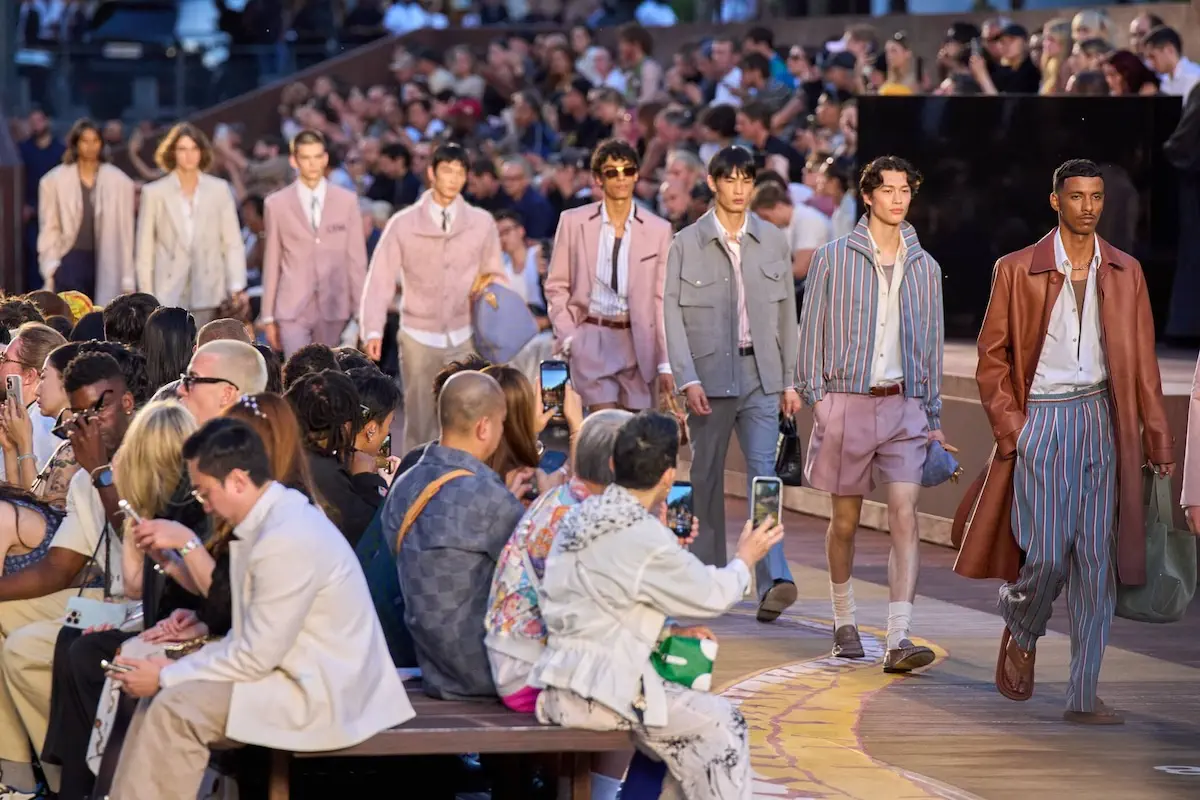
Paris Fashion Week Men’s enters a pivotal moment. For Fall/Winter 2026, the world’s most influential fashion capital welcomes a new generation of designers whose creative roots stretch far beyond France. From Riyadh to Tokyo, Barcelona to New Delhi, these emerging voices are redefining what it means to show in Paris and quietly reshaping the global balance of fashion power. From January 20th to 25th, 67 brands will present their Fall/Winter 2026 menswear collections. Within that lineup is a group of newcomers whose presence signals a shift in fashion’s power centers.
Paris Fashion Week Men’s embraces a broader global vision
The traditional markers of success within the French fashion system have long favored lineage, couture training, and a specific kind of polish. Yet the eight houses making their Paris debuts this season have different credentials. Eli Russell Linnetz’s ERL has built its following through a distinctly Californian lens. KML, founded by Saudi Arabian siblings Ahmed and Razan Hassan, earned recognition as an LVMH Prize semi-finalist without ever showing in Paris. Barcelona-based Sonia Carrasco offers a Spanish perspective, and Ssstein, founded by Japanese designer Kiichiro Asakawa, won the 2025 Fashion Prize of Tokyo before securing a spot on the Paris schedule.
These additions matter because they represent perspectives that were once peripheral to the conversation happening along the Seine. Their arrival suggests that, for all its history and institutional weight, Paris recognizes that relevance requires openness. The Fédération de la Haute Couture et de la Mode has published a provisional calendar that acknowledges this reality.
SPHERE Paris: a platform for emerging international talent
While the newcomers generate considerable attention, another dimension of Paris’s evolving fashion landscape is revealed through the SPHERE Paris Fashion Week Showroom at the Palais de Tokyo. Since January 2020, SPHERE has operated with support from DEFI and L’Oréal Paris to provide infrastructure for emerging designers who might otherwise lack the resources to properly present their work. This season, the showroom features seven brands that demonstrate the diversity of the new generation of international talent.
Cachí, founded by the Franco-Argentine duo Belén Frías and Élise Girault, won the AMI x IFM Entrepreneurship Prize in 2023 and launched commercially in 2024. Their work celebrates French and Argentinian craftsmanship, drawing from architecture and interior design. Vincent Frederic-Colombo’s C.R.E.O.L.E brand approaches fashion as a manifesto centered on the legacy of the Creole diaspora. It questions masculine wardrobe conventions through unisex codes and workwear-inspired silhouettes. The brand joined the Official Calendar of Paris Fashion Week presentations in 2023.
Rémy Guerra’s GARDOUCH transforms personal archives into clothing, building collections from reinterpreted micro-archives that examine what happens when memory becomes wearable. Guerra, a Gerrit Rietveld Academie graduate, taught himself to sew while studying video and installation. LA CAGE, founded by Victor Koehler and Victoria Baia while they were students at École Duperré, reimagines parade and ceremonial uniforms under the influence of 1990s cinema. The duo became finalists at the 39th Hyères International Fashion Festival in October 2024.
LAZOSCHMIDL, founded by the German-Swedish duo Andreas Schmidl and Josef Lazo in 2014, creates collections based on narratives inspired by pop culture and personal stories. The brand won the 2016 Innovation Prize from the Swedish Fashion Council and has appeared on the Paris Fashion Week Menswear Official Calendar since June 2019. OUEST Paris was launched by Arthur Robert in 2021, after he spent over a decade working as a designer for well-known Parisian fashion houses. The brand revisits urban wardrobe archetypes through a lens that fuses Paris with California. Robert, a finalist for the 2023 Pierre Bergé ANDAM Prize, was added to the Official Calendar in January 2024.
RKIVECITY, founded by Ritwik in New Delhi in the early 2020s, operates as a research and design laboratory focused on circularity. After studying at the Fashion Institute of Technology in New York and working on textile waste management projects in Gujarat’s Special Economic Zones, Ritwik developed zero-waste remanufacturing systems inspired by traditional techniques like boro and raffoo.
Established houses adapt to a changing fashion landscape
The established houses have not remained static while newcomers arrive. On January 21st, Jonathan Anderson will present his second menswear collection for Dior, and on January 24th, Véronique Nichanian will show her final collection for Hermès. Both shows have moved from their traditional time slots, a seemingly minor detail that suggests flexibility, even within the most structured parts of the schedule.
Magliano, the brand of Bologna-based designer Luca Magliano, has swapped its Milan runway for a Paris presentation. Kenzo has abandoned the runway format entirely this season, opting for a presentation at the former Paris residence of founder Kenzo Takada instead. In March, Loewe will transition to a coed format to present the first menswear collection from Creative directors Jack McCollough and Lazaro Hernandez, then return to a dedicated men’s show in June.
The calendar begins Tuesday afternoon with Parisian designer Jeanne Friot making her runway debut and concludes Sunday evening with Jacquemus. Louis Vuitton, Junya Watanabe, and Comme des Garçons maintain their customary positions. Through its inclusions and omissions, the schedule reveals that Paris Fashion Week continues to function as fashion’s most important stage. However, the criteria for who gets to perform there keep evolving.
Follow all the latest news from Fashionotography on Flipboard, or receive it directly in your inbox with Feeder.
You might also read

What the Fall/Winter 2026 season signals for fashion’s future
The presence of a new generation of international talent during the Fall/Winter 2026 season shows that geography no longer determines who is heard. Designers from New Delhi, Riyadh, Barcelona, and Tokyo now compete on an equal footing with designers from Paris, Milan, and New York. The SPHERE initiative provides practical support that recognizes talent and potential rather than pedigree alone.
Paris has always been aspirational, but aspiration takes different forms now. The brands showing this January built their reputations through different channels, spoke to different audiences, and developed their aesthetics outside the traditional atelier system. Some are self-taught. Others studied in Amsterdam or New York instead of Paris. Several launched their brands within the last few years. They arrived at this moment not by following a prescribed path, but by creating work that demanded attention.