



London’s Design Museum unveils a rare treasure: Wes Anderson’s personal archives, featuring more than 600 original objects from his most iconic films. From the candy-pink The Grand Budapest Hotel model to handwritten notebooks and award-winning costumes, this unprecedented retrospective offers a privileged look into the filmmaker’s meticulously crafted cinematic worlds, and the creative process behind them.
The exhibition runs through July 26, 2026, offering unprecedented access to materials stored since their original use on set.
Walking through the galleries, visitors encounter the monumental candy-pink façade of The Grand Budapest Hotel. Spanning over three meters, the model captures the building that anchored Anderson’s 2014 film. It sits among storyboards, Polaroids, sketches, and handwritten notebooks that trace the director’s creative evolution from Bottle Rocket to his recent work.

The archive that almost never existed
Anderson’s meticulous collecting habit began after a painful lesson: Everything made for Bottle Rocket was owned by the production company and subsequently sold off. From Rushmore onward, he personally safeguarded every item crafted after shooting concluded. Nearly thirty years later, this habit has resulted in thousands of objects illuminating his filmmaking process.
“Each Wes Anderson film plunges viewers into a world with its own codes, motifs, and references. The sets and costumes are sumptuous and instantly recognizable,” says Lucia Savi, Head of Curatorial and Interpretation at the Design Museum and co-curator of Wes Anderson: The Archives. “Every single object in a Wes Anderson film is very personal to him. They are not simply props; they are fully formed pieces of art and design that bring his inventive worlds to life.”
The exhibition follows a chronological path through his career. You begin with his 1996 feature debut and move through sections dedicated to individual films. Rare among filmmakers, Anderson ensures that what appears on screen exists physically. These are not mere props created for fleeting camera angles. He remains closely involved in commissioning and creating each piece, even those visible for only seconds.

How costumes shape Wes Anderson’s iconic characters
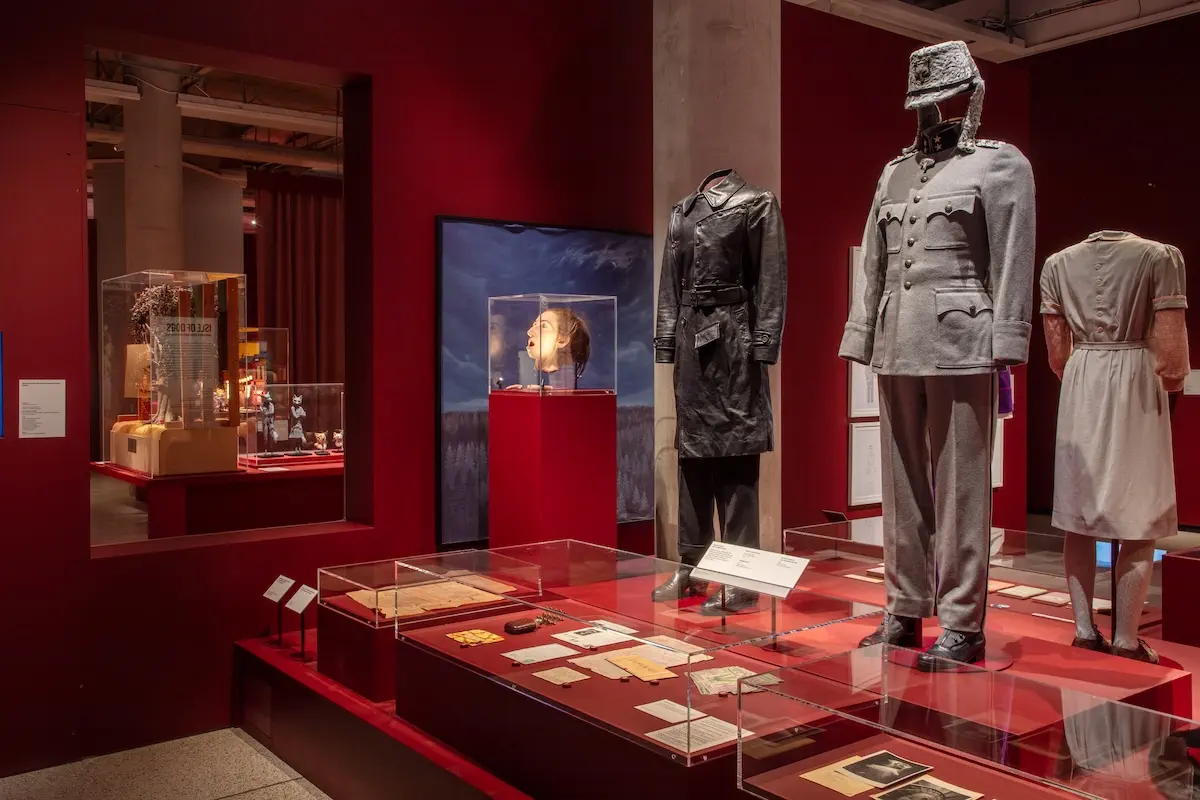
The costume collection reveals how Anderson works with actors to create characters through clothing. Gwyneth Paltrow’s FENDI fur coat, which she wore as Margot Tenenbaum, hangs alongside Max Fischer’s Rushmore Academy uniform. The full Zissou crew ensembles from The Life Aquatic with Steve Zissou occupy their own space, showcasing the film’s signature aesthetic.
Oscar-winning costumes from The Grand Budapest Hotel dominate one section. Milena Canonero received the Academy Award for Costume Design in 2014 for her work on the film. Ralph Fiennes’s Gustave H. concierge costume is displayed alongside the coat, dress, and accessories worn by Tilda Swinton‘s character, Madame D. Costumes worn by Waris Ahluwalia, Seu Jorge, Scarlett Johansson, Bill Murray, Jason Schwartzman, Ben Stiller, Owen Wilson, and Jeffrey Wright fill the galleries.
Nearby sits Moses Rosenthaler’s costume, worn by Benicio del Toro in The French Dispatch. The fabrics, tailoring, and period-specific details demonstrate how clothing becomes inseparable from character identity in Anderson’s work.

Follow all the latest news from Fashionotography on Flipboard, or receive it directly in your inbox with Feeder.
You might also read

Inside the handcrafted stop-motion worlds
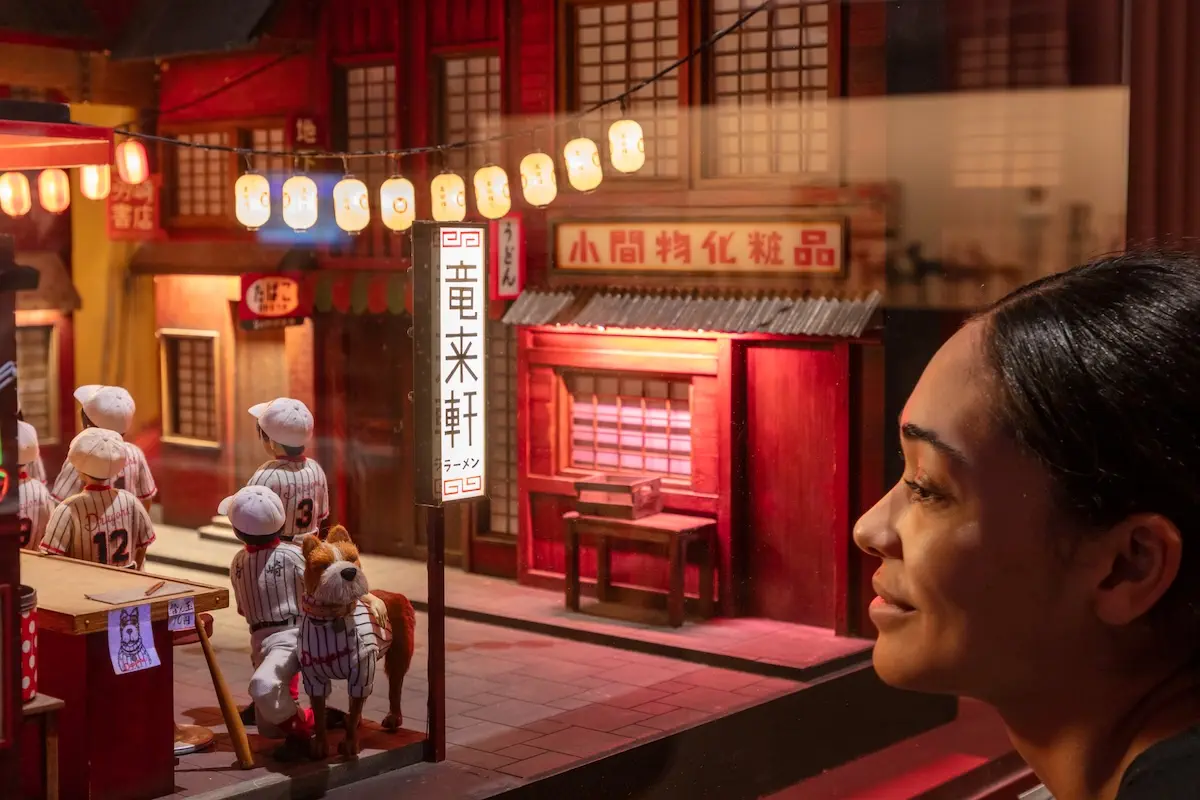
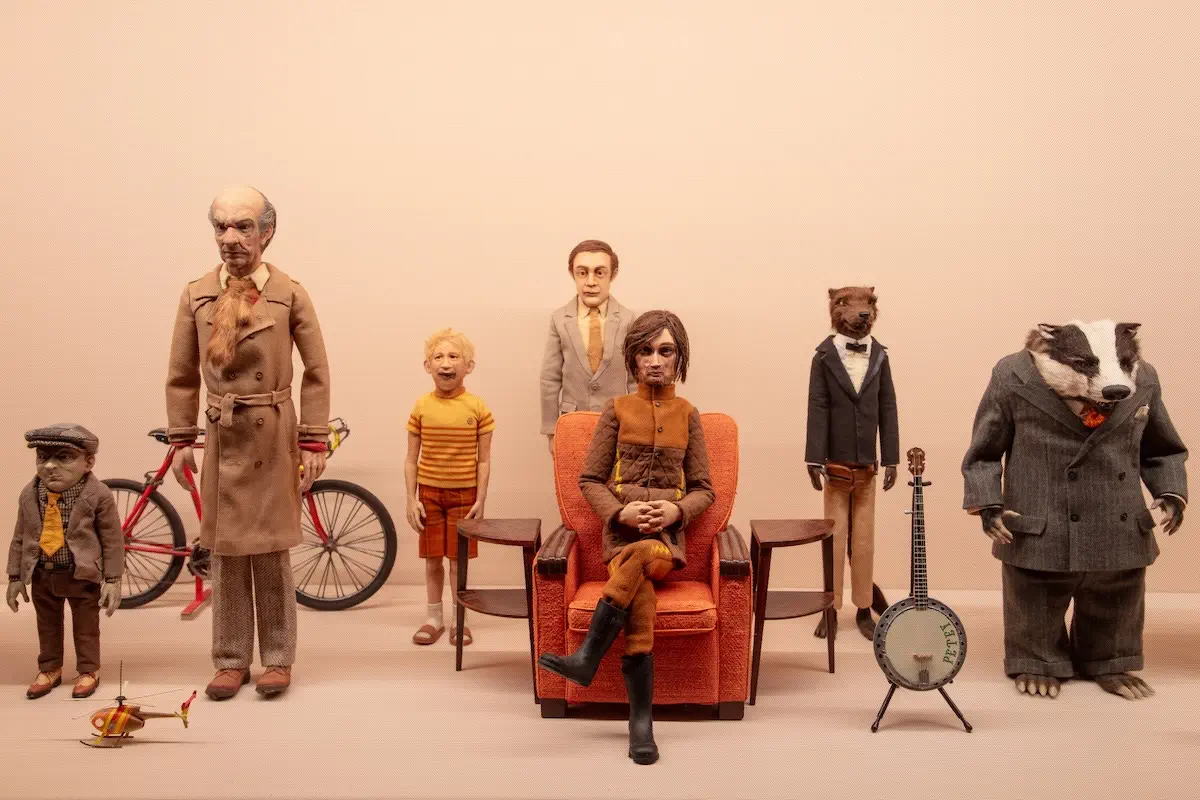
The sections devoted to Fantastic Mr. Fox and Isle of Dogs reveal Anderson’s miniature craftsmanship. Original puppets of various sizes are on display, including Mr. Fox in his signature corduroy suit and show dog Nutmeg. Meticulously built miniature sets surround the puppets, showcasing the painstaking construction required for stop-motion animation.
Original stop-motion puppets depicting fantastical sea creatures from The Life Aquatic with Steve Zissou demonstrate Anderson’s use of traditional filmmaking techniques. Work-in-progress materials and maquettes illustrate the evolution from concept to finished product. The exhibition emphasizes handmade film techniques that persist despite digital alternatives.
Objects, artworks, and hidden film details
The Boy with Apple painting hangs prominently. Although the painting is presented as a priceless Renaissance portrait that Ralph Fiennes’ character inherits in The Grand Budapest Hotel, it is actually a contemporary work by British artist Michael Taylor. Anderson commissioned the painting specifically for the film, blurring the line between prop and artwork.
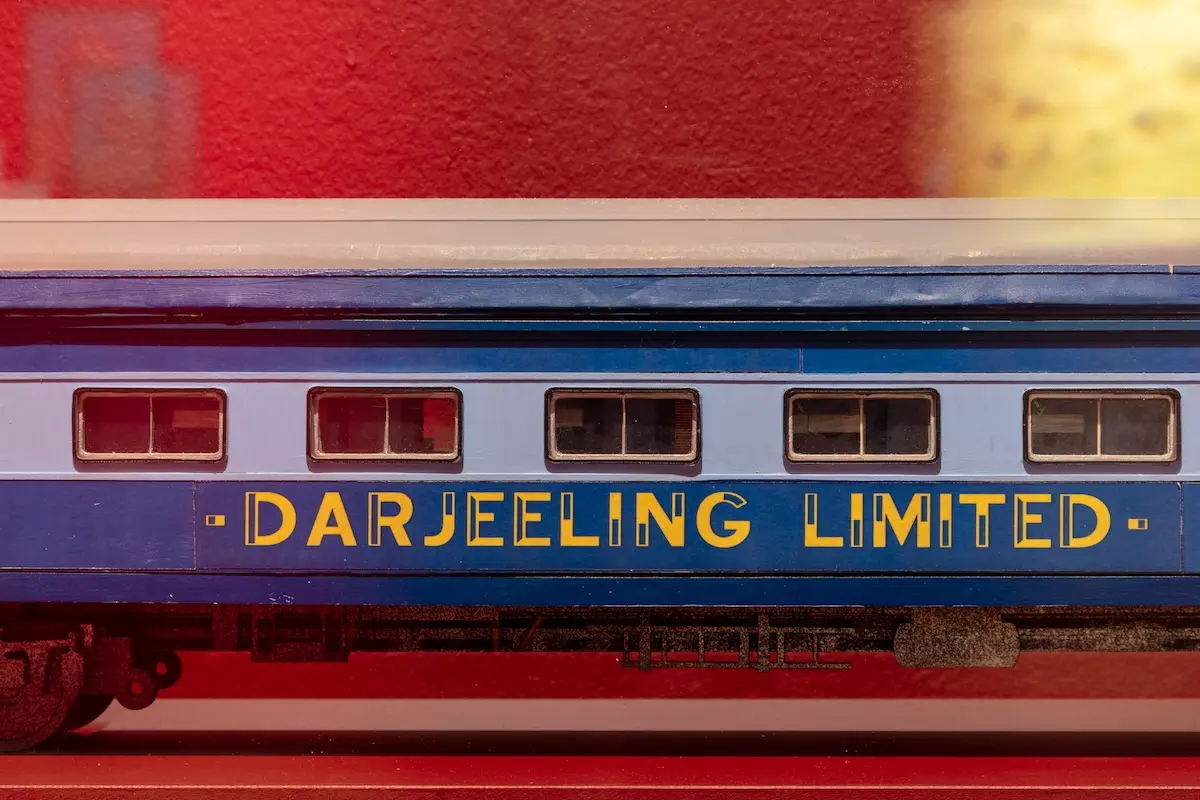
Vending machines from Asteroid City occupy one corner. Anderson’s spiral-bound notebooks, filled with handwritten ideas, early film inspirations, character concepts, script notes, and scene sketches, offer rare access to his creative process. His characteristic handwriting fills the pages with diagrams and annotations that illustrate how ideas evolve into films.
The exhibition gallery screens Anderson’s 1993 short film Bottle Rocket. Created before the feature-length version and starring Owen Wilson, the 14-minute film rarely appears publicly. Watching it within the exhibition context reveals how Anderson’s visual vocabulary was already taking shape.
A collaborative vision behind the Anderson universe
“It’s a gift that Wes Anderson, even as a young filmmaker, had the foresight to save all his props and beautifully crafted objects for his archive,” says Johanna Agerman Ross, chief curator at the Design Museum and co-curator of Wes Anderson: The Archives. “We are thrilled to be the first to fully explore the archive’s riches.”
The exhibition highlights Anderson’s long-standing creative partnerships. Works by Eric Chase Anderson, Javi Aznarez, Milena Canonero, Roman Coppola, Alexandre Desplat, Erica Dorn, Mark Friedberg, Andy Gent, Juman Malouf, Roger Do Minh, Sylvia Plachy, Carl Sprague, Simon Weisse, and Laura Wilson are featured.
Tim Marlow, the Design Museum’s director and CEO, observes: “Wes Anderson has created some of the most visually distinctive and emotionally resonant films of the last two decades—from the melancholic charm of The Royal Tenenbaums to the youthful adventurism of Moonrise Kingdom. He’s an utterly compelling creator of cinematic worlds whose singular vision and attention to detail are underpinned by an acute understanding of design and craftsmanship. This is precisely why the Design Museum is the perfect location for this landmark retrospective.“

From Paris to London: The expanded exhibition
The exhibition originated at La Cinémathèque Française in Paris, where it premiered in March 2025. The London presentation has over 100 additional objects and is significantly expanded. The Design Museum version emphasizes Anderson’s world-building design process and his collaborators’ contributions.
The Design Museum granted unprecedented access to its archives, which were built over three decades. Most of the objects have remained in storage since their original use. Seeing them together reveals patterns in Anderson’s aesthetic choices and his commitment to physical craftsmanship over digital shortcuts.
An extensive catalog accompanies the exhibition and was published by the Design Museum in collaboration with Anderson. The catalogue features essays by leading design and film writers, unique photography, and interviews with collaborators, including Owen Wilson, Scarlett Johansson, Jason Schwartzman, Tilda Swinton, Alexandre Desplat, Seu Jorge, and Randall Poster.


FAQ
What is featured in the Wes Anderson retrospective at the Design Museum?
The exhibition showcases over 600 original objects from Anderson’s films, including costumes, miniatures, puppets, notebooks, artwork, and set models.
How long will the Wes Anderson exhibition run in London?
The retrospective is open until July 26, 2026, giving visitors ample time to explore Anderson’s creative universe.
Is the exhibition different from the Paris version at the Cinémathèque Française?
Yes. The London edition includes over 100 additional objects and expands significantly on the Paris presentation.
Can visitors see original props and costumes from Anderson’s most iconic films?
Absolutely. Items from The Grand Budapest Hotel, The Royal Tenenbaums, Fantastic Mr. Fox, The French Dispatch, and more are on display.
Are photographs allowed inside the exhibition?
Photography guidelines vary by object and area; visitors should check signage or consult museum staff upon arrival.